

Single Phase vs Three Phase Power Explained
Homes usually run on single phase power, while factories and large buildings use three phase. The difference changes how much current a load draws, how big the cables must be, and which motors you can run. This guide explains single phase vs three phase power with the formulas and a side by side example.
How single phase power works
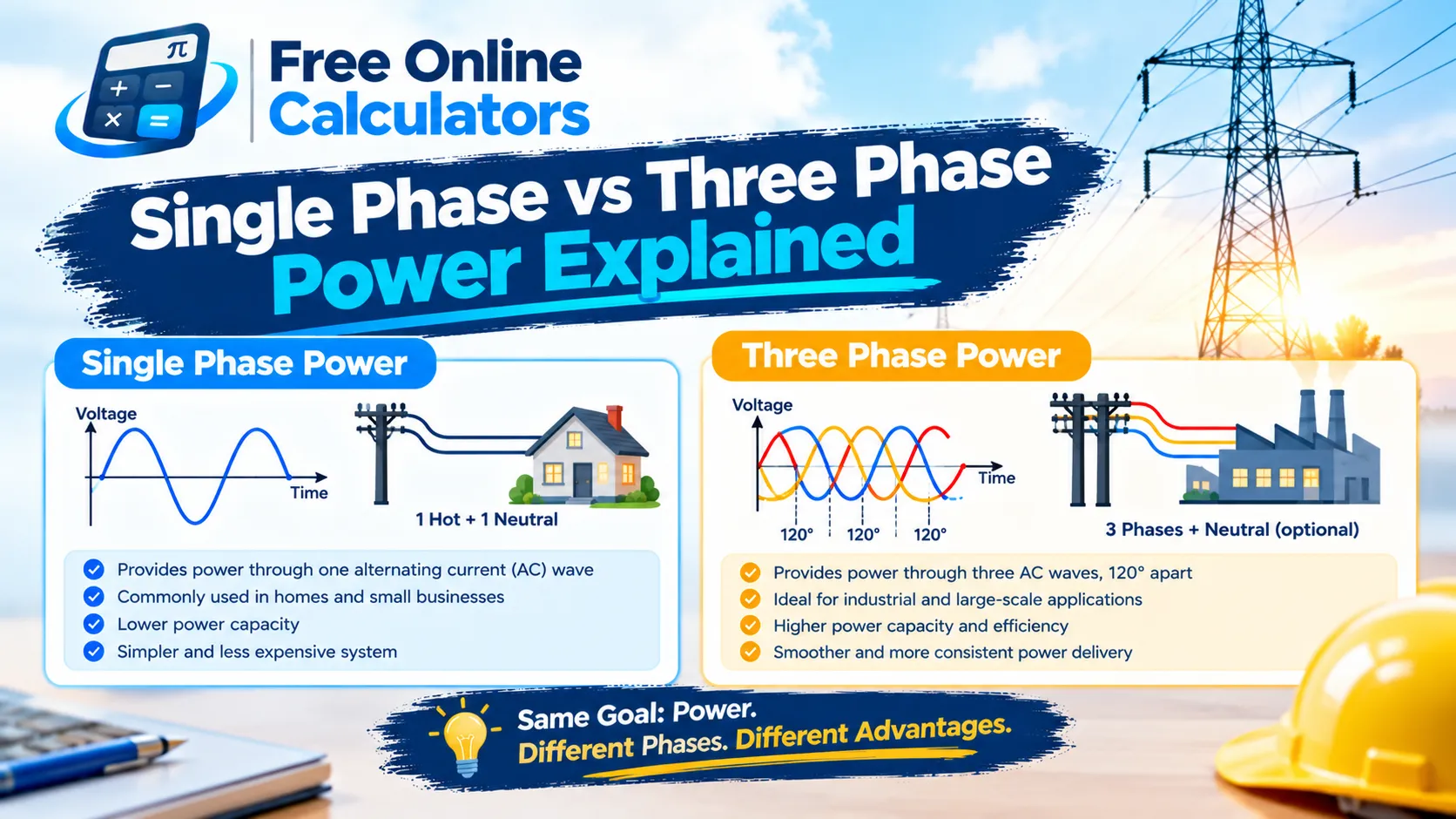
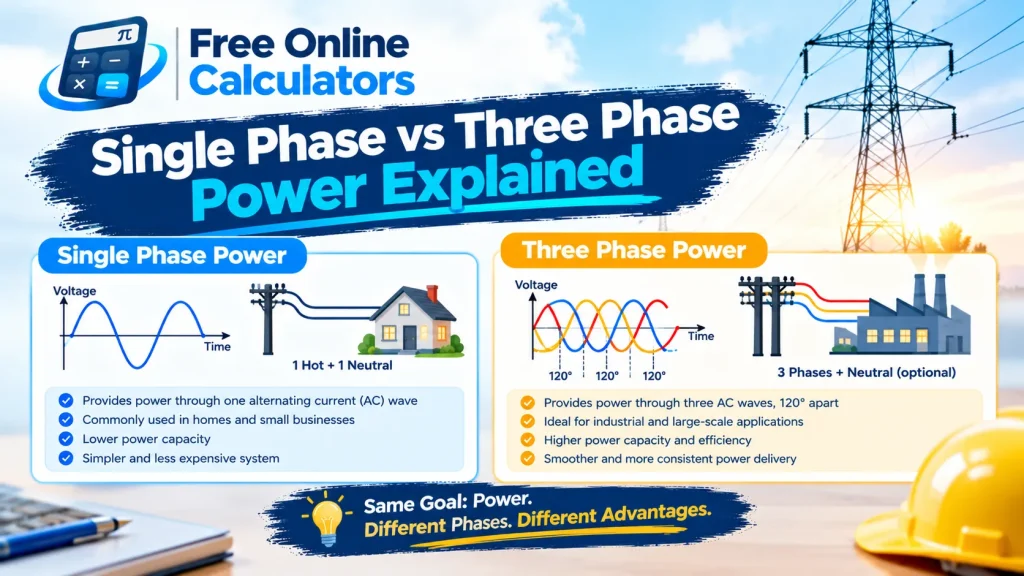
A single phase supply has one alternating voltage that rises and falls 50 or 60 times a second, crossing zero twice in each cycle. Power delivery pulses with it. In North America, homes get a split-phase 120/240 V service; much of the world uses 230 V single phase.
P = V × I × PF
How three phase power works
Three phase power uses three voltages spaced 120 degrees apart, so one is always near its peak. Power flows smoothly instead of pulsing, and motors start and run without extra parts. Common voltages are 208 V and 480 V in North America and 400 V in much of the world.
P = √3 × VL × I × PF
VL is the line-to-line voltage. The full set of three phase formulas is in the three phase power calculator.
Same load, different current
A 10 kW resistive load (power factor 1.0):
- Single phase, 240 V: I = 10,000 ÷ 240 = 41.7 A.
- Three phase, 400 V: I = 10,000 ÷ (1.732 × 400) = 14.4 A per line.
Lower current means smaller conductors for the same power, which is why three phase wins for large loads. The steps to convert current to power in both systems are in the amps to kW formula guide.
Single phase vs three phase compared
| Feature | Single phase | Three phase |
|---|---|---|
| Conductors | 2 or 3 | 3 or 4 |
| Power flow | Pulsing | Smooth |
| Typical use | Homes, small shops | Factories, large buildings, data centers |
| Motors | Need start capacitors above small sizes | Self-starting, smaller for the same power |
| Cable per kW | More | Less |
Sizing equipment for each supply
Generators and transformers are rated in kVA, and the kW they deliver depends on the power factor. That conversion works the same on single and three phase, as the kVA to kW conversion guide shows. Cable size then follows from the current and the run length.
How to tell which supply you have
- Count the hot conductors at the main panel: one or two for single phase, three for three phase.
- Check the main breaker: a three-pole main usually means three phase.
- Read the meter or ask the utility.
Common mistakes
- Using the single phase formula on a three phase load. Include √3.
- Mixing phase and line voltage. Use line-to-line voltage in the three phase formula.
- Forgetting power factor on motors. Real kW is below V × I.
Once you know the current, size the conductors with the wire size calculator.
Quick reference
Single phase: P = V × I × PF. Three phase: P = 1.732 × VL × I × PF. Work out any load with the free electrical tools on CalculateGuide.