

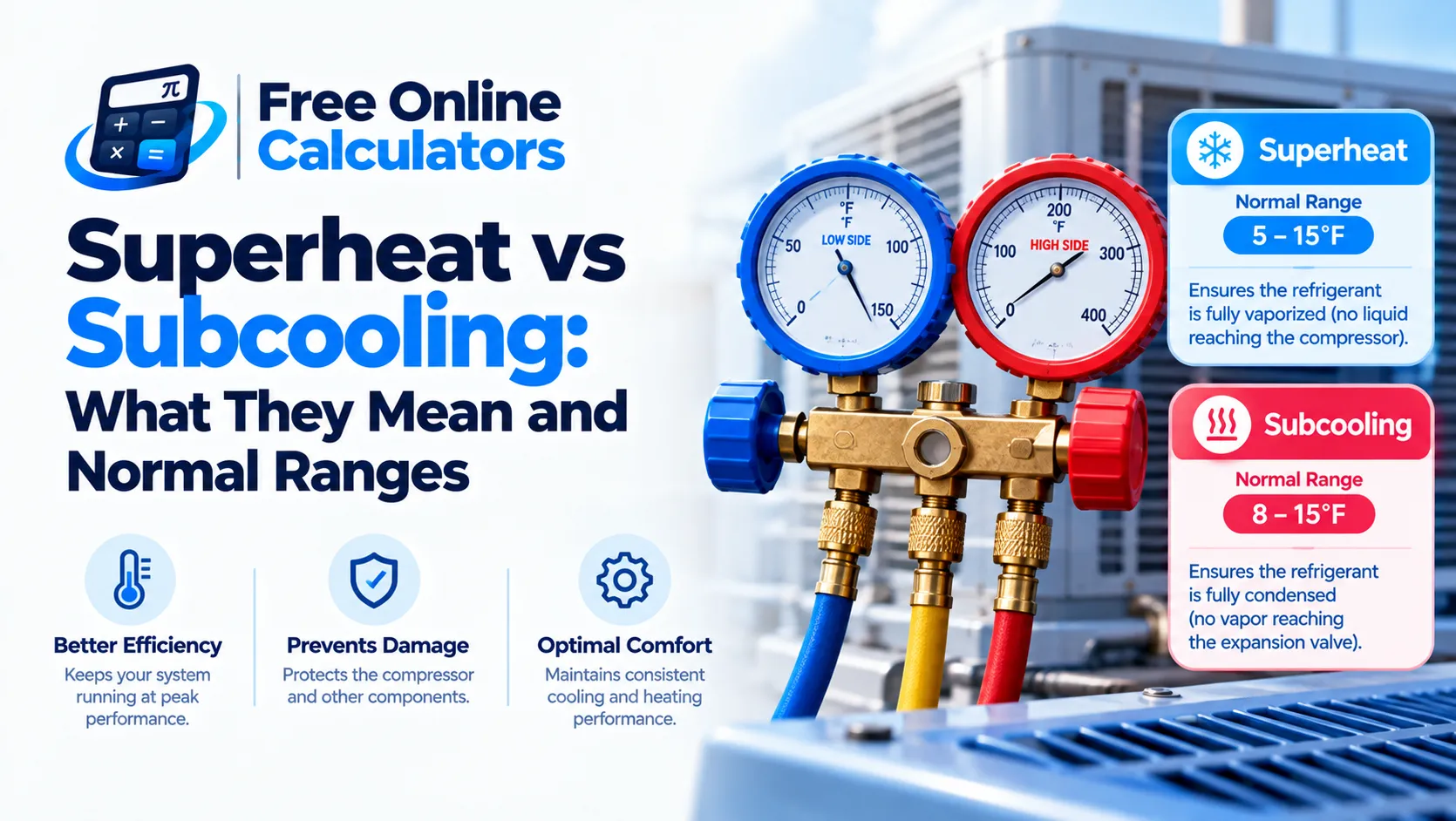
Superheat vs Subcooling: What They Mean and Normal Ranges
Superheat and subcooling are the two readings technicians use to judge the refrigerant charge of an air conditioner or heat pump. Superheat looks at the vapor leaving the evaporator; subcooling looks at the liquid leaving the condenser. This guide explains superheat vs subcooling, how to measure each, normal ranges, and which one to charge by.
What superheat is
Superheat is how far the suction vapor has warmed above its boiling point:
Superheat = Suction line temperature − Evaporator saturation temperature
Read the suction pressure, convert it to a saturation temperature with a pressure-temperature chart for the refrigerant, and subtract that from the suction line temperature measured near the service valve. Low superheat means liquid may reach the compressor; high superheat means the evaporator is starved.
What subcooling is
Subcooling is how far the liquid has cooled below its condensing point:
Subcooling = Condenser saturation temperature − Liquid line temperature
Read the liquid line pressure, convert it to a saturation temperature, and subtract the liquid line temperature. Subcooling shows how much liquid is stacked in the condenser; it rises with too much charge and falls with too little.
Worked R-410A example
- Suction pressure 118 psig = about 40°F saturation. Suction line 50°F. Superheat = 10°F.
- Liquid pressure 365 psig = about 110°F saturation. Liquid line 100°F. Subcooling = 10°F.
Both readings sit in a normal range for a system with a TXV. The superheat and subcooling calculator does the pressure to temperature step for common refrigerants.
Normal superheat and subcooling ranges
| Reading | Typical target | Notes |
|---|---|---|
| Superheat, TXV system | 8 to 12°F | The TXV holds it fairly steady |
| Superheat, fixed orifice | About 5 to 30°F | Set from indoor wet bulb and outdoor dry bulb |
| Subcooling, TXV system | 8 to 12°F | Use the value on the unit data plate |
The manufacturer target always wins. Many condensers list the required subcooling on the data plate.
Superheat vs subcooling: which one to charge by
- Fixed orifice or piston systems: charge by superheat, using a target chart.
- TXV or EEV systems: charge by subcooling, because the valve controls superheat on its own.
Fixed orifice targets depend on the indoor wet bulb, which the wet bulb calculator finds from temperature and humidity.
What the two readings tell you together
| Superheat | Subcooling | Likely cause |
|---|---|---|
| High | Low | Undercharge or leak |
| Low | High | Overcharge |
| High | High | Restriction in the liquid line or metering device |
| Low | Low | Low airflow over the evaporator or a weak compressor |
Common mistakes
- Charging a TXV system by superheat. Use subcooling.
- Measuring before the system settles. Run it 10 to 15 minutes first.
- Ignoring airflow. A dirty filter or coil skews both readings.
Before blaming the charge, confirm the system size suits the house with the AC tonnage calculator.
Quick reference
Superheat = suction line − evaporator saturation; subcooling = condenser saturation − liquid line. Run the numbers with the HVAC tools on CalculateGuide.