

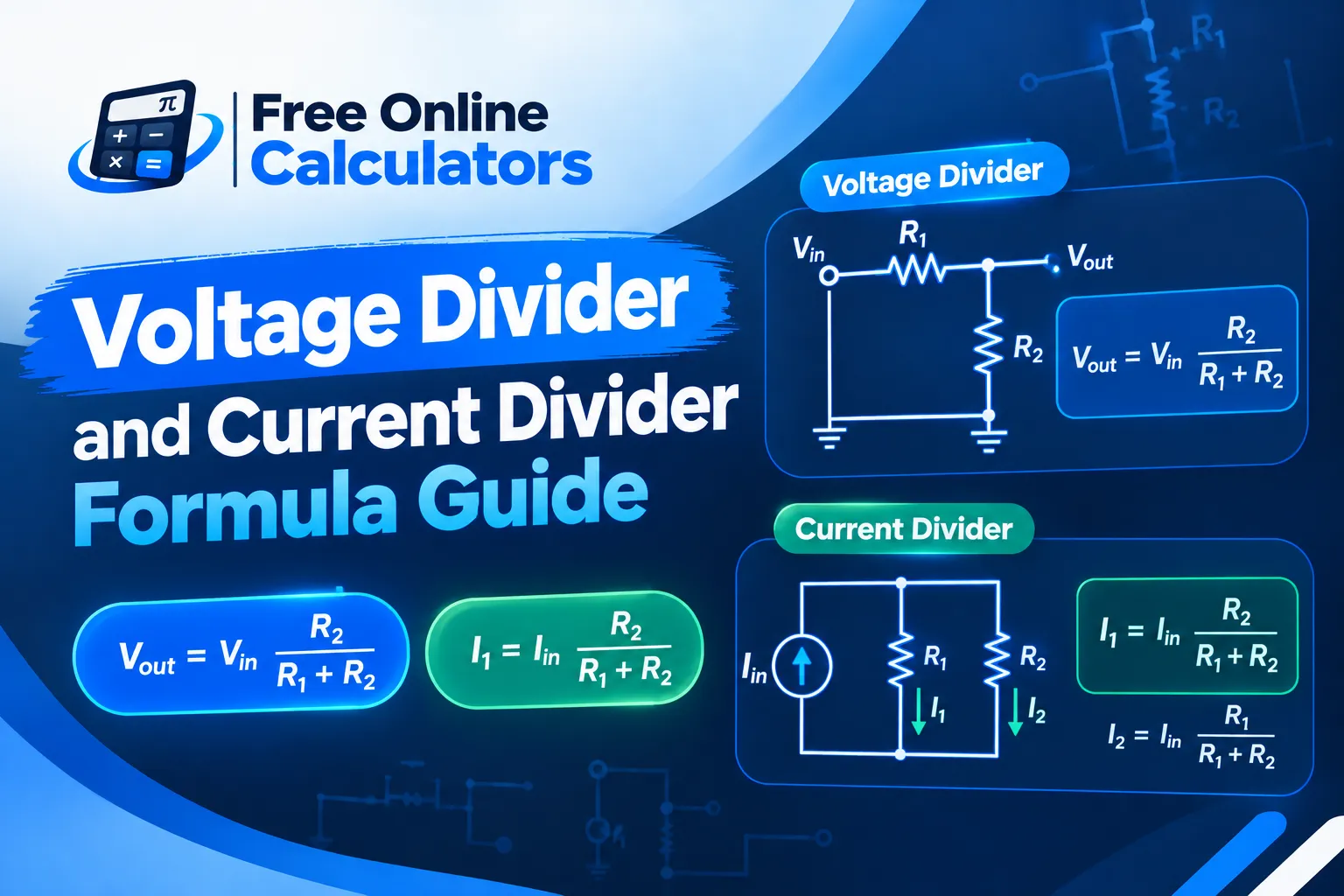
Voltage Divider and Current Divider Formula Guide
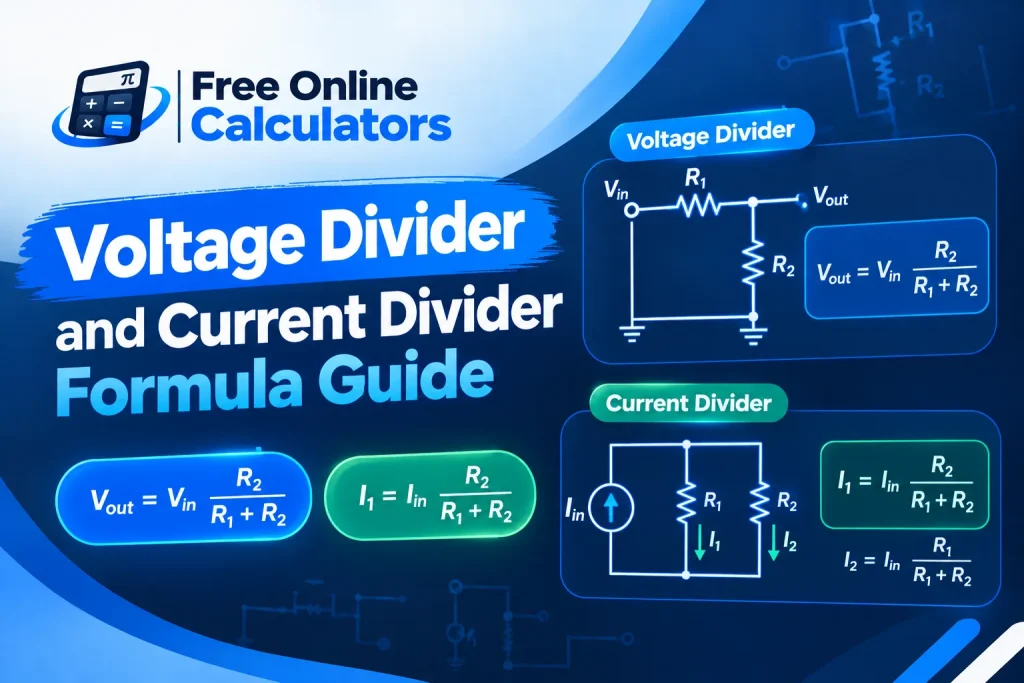
The voltage divider formula and the current divider formula are two of the first tools every electronics beginner meets, and they stay useful for a lifetime. This guide explains both, shows the equations, and covers the loading effect that trips people up.
The voltage divider formula
A voltage divider is two resistors in series that split an input voltage. The output, taken from the junction between them, is set by the voltage divider formula:
Vout = Vin × R2 ÷ (R1 + R2)
R1 is the top resistor, R2 is the lower one, and the output is measured across R2. The voltage divider equation scales the input by the ratio of the lower resistor to the total. The voltage divider calculator applies it and also reports the current and the ratio.
Voltage divider example
With 12 V in, R1 = 1 kΩ, and R2 = 2 kΩ, the output is 12 × 2000 ÷ 3000 = 8 V.
The current divider formula
When current reaches two resistors in parallel, it splits between them in inverse proportion to their resistance. The parallel resistance calculator gives the combined value of the pair. The current divider formula for the current through one resistor is:
I1 = I × R2 ÷ (R1 + R2)
The larger share of current takes the path of lower resistance. This is the companion to the voltage divider circuit formula, and both come straight from Ohm’s law.
The loading effect
The voltage divider formula assumes nothing draws current from the output. Connect a load across R2 and the effective resistance drops, so the real output sits below what the potential divider formula predicts. Keep the load resistance at least ten times R2, or buffer the output with an op-amp, to stay accurate. For fixed resistor networks, the series resistance calculator adds the values in a chain.
Common mistakes
- Ignoring the load. An unloaded voltage divider formula result sags once you draw current.
- Swapping R1 and R2. The output is across the lower resistor, so swapping them inverts the ratio.
- Resistors too small. Tiny values waste current continuously, which matters in battery devices.
Quick reference
Voltage divider: Vout = Vin × R2 ÷ (R1 + R2). Current divider: I1 = I × R2 ÷ (R1 + R2). Test values on any free online calculator from CalculateGuide.