

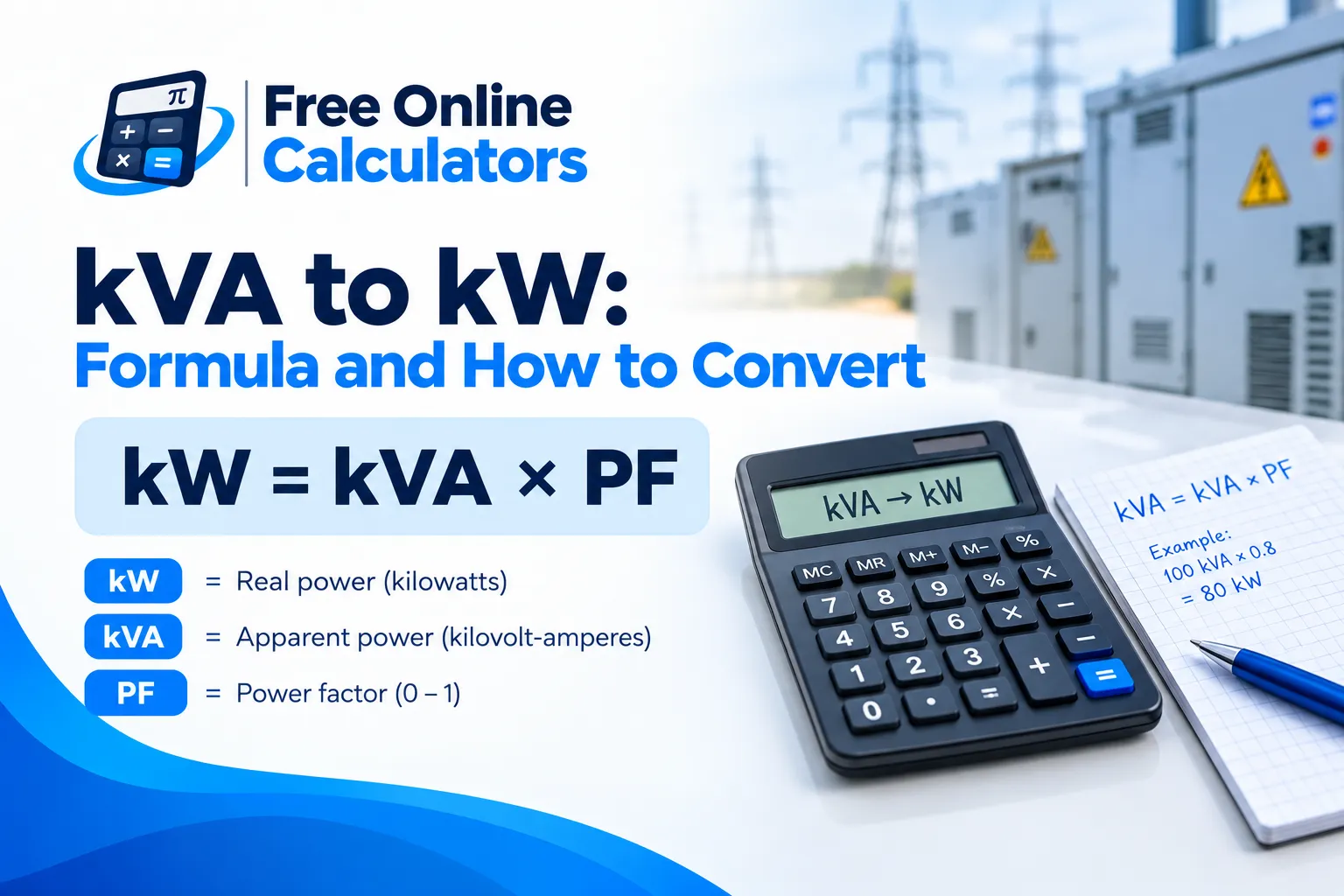
kVA to kW: Formula and How to Convert
kVA is apparent power and kW is real power. Converting kVA into kW is a common job when you size generators and transformers, and it comes down to one number: the power factor.
The kVA to kW formula
The kVA to kW formula multiplies apparent power by the power factor:
kW = kVA × PF
PF is the power factor, a value between 0 and 1. Because the power factor already carries the phase relationship, the same formula works for single phase and three phase, so there is no separate three phase version. The kVA to kW calculator does the conversion for you.
Worked example
A 100 kVA transformer at a power factor of 0.8: kW = 100 × 0.8 = 80 kW. To convert 1 kVA into kW at the same power factor you get 0.8 kW, and every value scales the same way. If you start from a current reading instead, the amps to kW formula gets you to kW first.
Why power factor matters
In a purely resistive load the power factor is 1.0 and the kVA equals the kW. Add motors, transformers, or fluorescent gear and the current lags the voltage, the power factor drops, and part of the apparent power becomes reactive power that does no work. That is why every conversion needs the power factor. The power factor calculator finds the value to use.
Sizing on the right number
Size generators and transformers on the real load they must carry. A low power factor means more of the kVA is wasted, so the kW falls well below the kVA. When you need to go the other way, the kW to kVA calculator reverses the conversion.
Common mistakes
- Assuming kVA equals kW. That only holds at a power factor of 1.0.
- Looking for a separate 3 phase formula. Once you have the kVA, the formula is the same.
- Entering power factor as a percent. Use a decimal, so 80 percent becomes 0.8.
Quick reference
kVA to kW: kW = kVA × power factor. Use 0.8 as a safe default for mixed motor loads. Convert instantly with any free online calculator on CalculateGuide.