

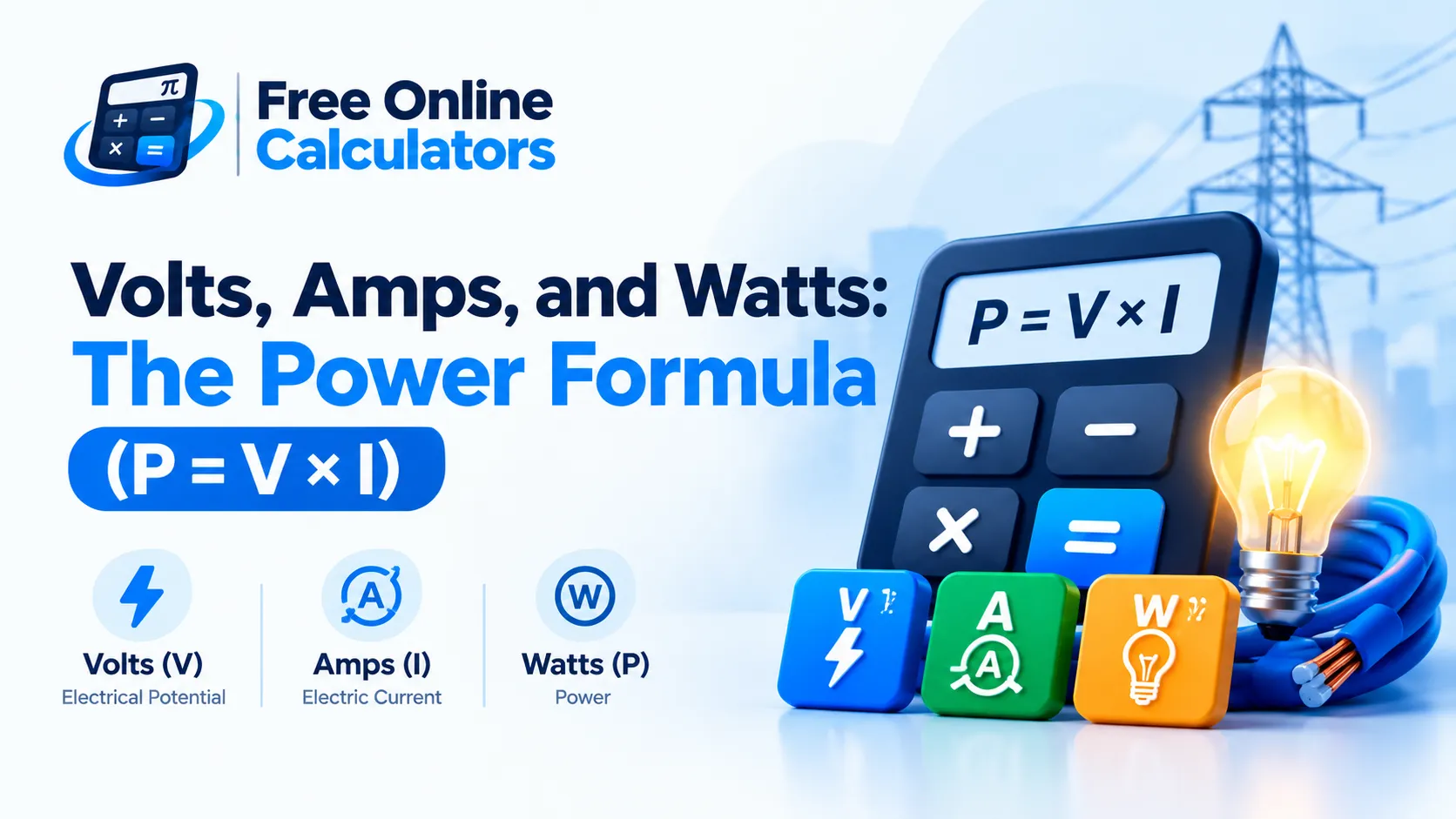
Volts, Amps, and Watts: The Power Formula (P = V × I)
Volts, amps, and watts are tied together by one relationship. Once you know any two, the third follows. This guide covers the volts amps watts formula and how to rearrange it for each unknown.
The volts amps watts formula
Power equals voltage times current:
W = V × A
W is power in watts, V is voltage in volts, and A is current in amps. This holds for DC and single phase AC at unity power factor; three phase adds the square root of three and the power factor. The volts to watts calculator multiplies the two for you.
Rearranging for each unknown
The same formula gives three conversions:
- Watts from volts and amps: W = V × A. A 230 V load at 10 A uses 2300 W.
- Amps from volts and watts: A = W ÷ V. A 2300 W load on 230 V draws 10 A. See the volts to amps calculator.
- Volts from watts and amps: V = W ÷ A. A 1000 W load at 5 A runs at 200 V.
Why you cannot skip a value
Voltage alone tells you nothing about power, and current alone does not either. You always need two of the three. The same product can be reached in different ways: a high voltage at low current, or a low voltage at high current, which is why high current circuits use heavier cable.
Bringing in resistance
When you know resistance instead of one of the three, Ohm law links voltage, current, and resistance (V = I × R). The Ohm law calculator ties all four quantities together.
Common mistakes
- Using one value. You need two of volts, amps, and watts to find the third.
- Ignoring power factor. On motor loads the real watts fall below volts times amps.
- Mixing single and three phase. Three phase needs the square root of three factor.
Quick reference
W = V × A, A = W ÷ V, V = W ÷ A. Convert any pair with the free electrical tools on CalculateGuide.