

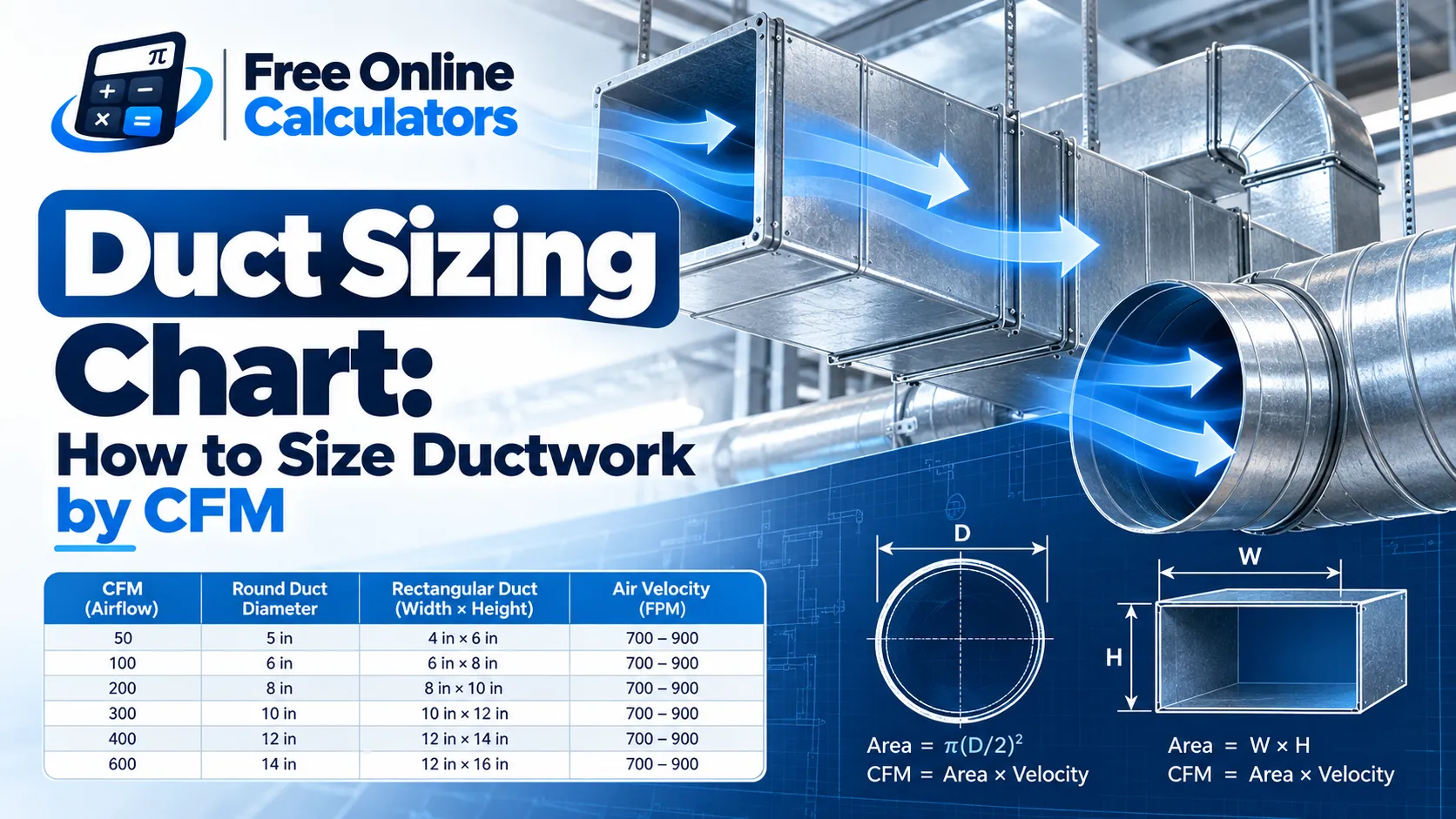
Duct Sizing Chart: How to Size Ductwork by CFM
A duct has to carry a set airflow without the air moving so fast that it whistles or so slow that it drops its heat. A duct sizing chart lists the round duct size for each airflow, and this guide shows the chart and the formula behind it.
How duct sizing works
You first find the cross section the airflow needs, then turn that area into a round diameter:
Area (ft²) = CFM ÷ velocity (ft/min)
Diameter (in) = 2 × √(Area × 144 ÷ π)
Higher velocity packs the same airflow into a smaller duct but adds noise and pressure loss. The duct size calculator lets you set the velocity and returns the diameter.
Duct sizing chart at 800 ft/min
Round duct diameter for common airflows at a typical supply velocity of 800 ft/min: 100 CFM needs about 4.8 in, 200 CFM about 6.8 in, 400 CFM about 9.6 in, 600 CFM about 11.7 in, 1000 CFM about 15.1 in, and 2000 CFM about 21.4 in. This is the same as any CFM duct chart in a manual; only the fixed velocity changes the numbers.
Design velocities
Supply trunks run near 800 to 900 ft/min, branches around 600, and returns lower still for quiet operation. Slower air needs a bigger duct but runs quieter and loses less pressure. Flexible duct needs a size bump over rigid metal, because its ribbed wall drags more. Rooms with a set ventilation rate, such as kitchens and bathrooms, take their airflow from the air changes per hour requirements table.
From airflow to fan
Sizing starts from airflow: the CFM calculator finds the airflow a room needs.
Once the duct is sized, the fan must push air through it, and the fan power calculator shows the power that takes.
Common mistakes
- One velocity for every run. Returns should run slower than supply trunks.
- Ignoring flex duct drag. Bump flexible runs one size over rigid metal.
- Not rounding up. Pick the next stock size for lower noise and pressure loss.
Quick reference
Area = CFM ÷ velocity; diameter = 2 × √(area × 144 ÷ π). Size any run with an online calculator free of sign-ups on CalculateGuide.