

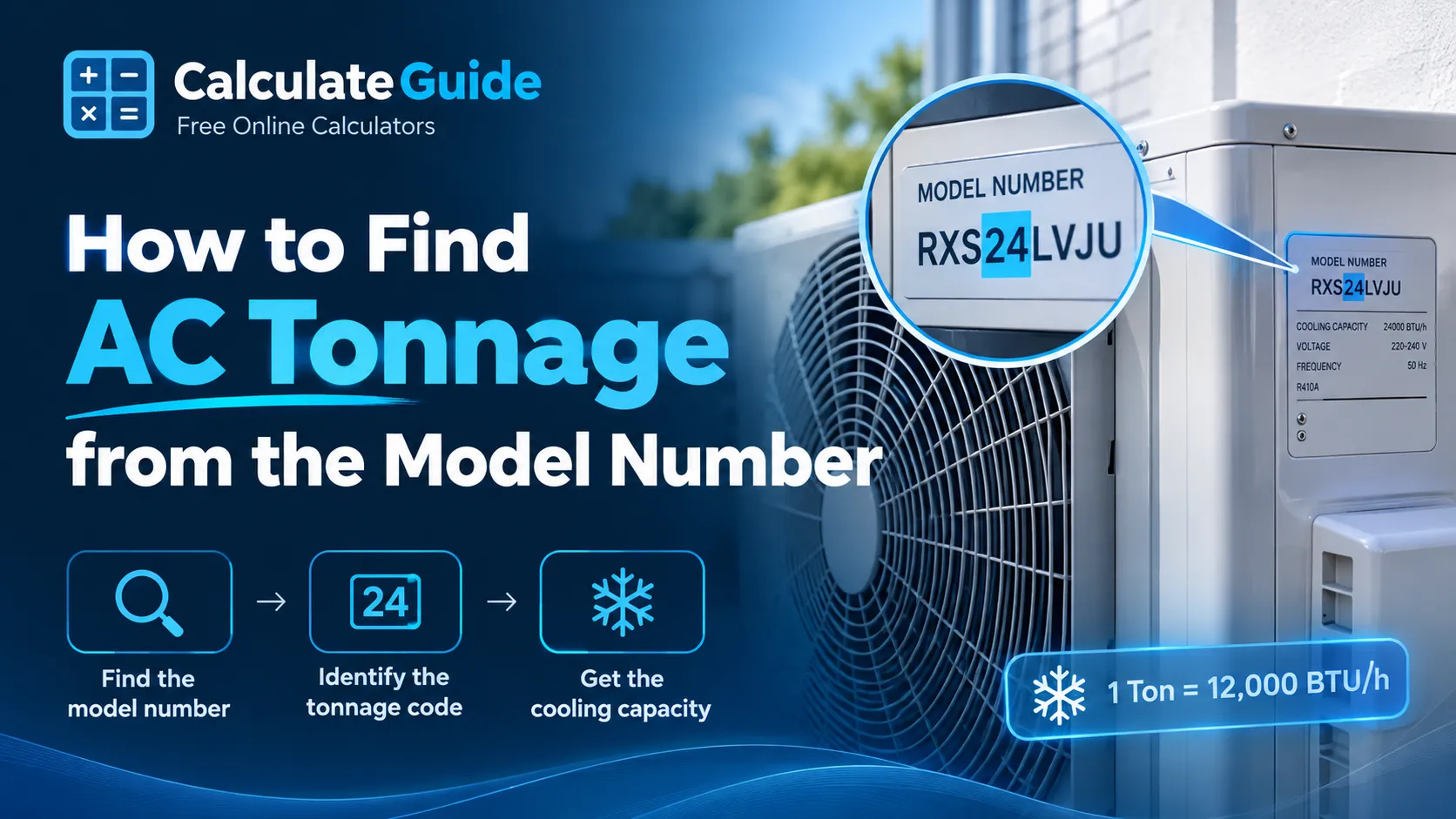
How to Find AC Tonnage from the Model Number
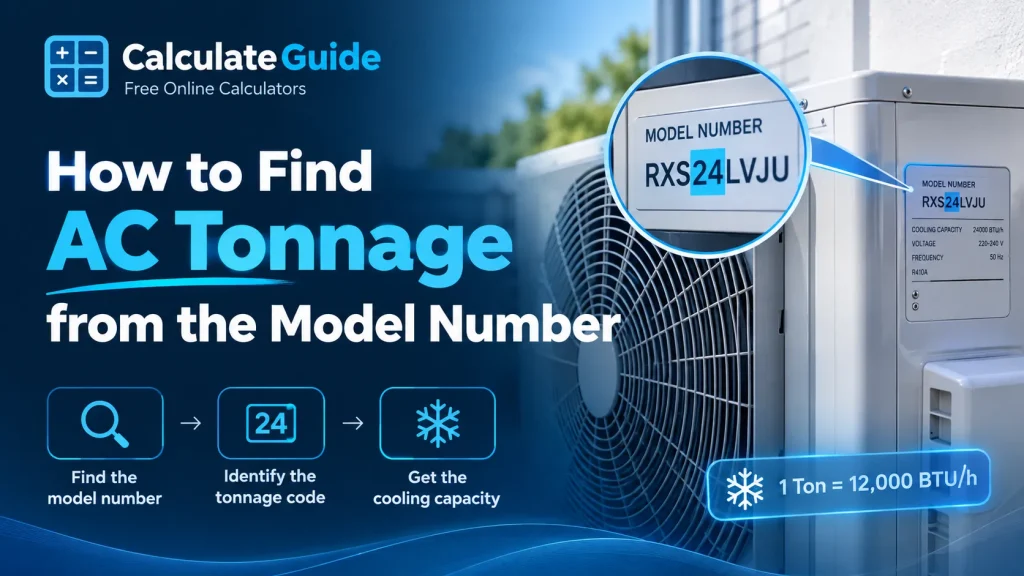
Every central air conditioner hides its size in the model number on the outdoor unit. Once you know where to look, you can find the tonnage of an AC unit in under a minute, with no tools and no calculations beyond one division. This guide shows how to find the tonnage of an HVAC unit from the model number, with brand examples.
Where to find the model number
Go to the outdoor unit, the condenser with the large fan on top. The data plate is a metal or foil label on the side or back panel. It lists the model number, the serial number, and electrical data. Use the outdoor unit, not the indoor air handler or furnace, because the condenser sets the cooling capacity.
How to determine AC tonnage from the model number
Look for a two or three digit number inside the model number that is a multiple of 6: 18, 24, 30, 36, 42, 48, or 60. That number is the cooling capacity in thousands of BTU per hour. One ton of cooling is 12,000 BTU per hour, so:
Tons = BTU per hour ÷ 12,000
A model number containing 36 means 36,000 BTU per hour, and 36,000 ÷ 12,000 = 3 tons. Some brands pad the code with a zero, so 036 means the same thing.
AC tonnage chart by model number code
| Code in model number | BTU per hour | Tons |
|---|---|---|
| 18 or 018 | 18,000 | 1.5 |
| 24 or 024 | 24,000 | 2 |
| 30 or 030 | 30,000 | 2.5 |
| 36 or 036 | 36,000 | 3 |
| 42 or 042 | 42,000 | 3.5 |
| 48 or 048 | 48,000 | 4 |
| 60 or 060 | 60,000 | 5 |
Ductless mini splits and window units often use 09 or 12, meaning 9,000 or 12,000 BTU per hour, or 0.75 and 1 ton.
How to find the tonnage of a Carrier AC unit
Carrier condensers use a series code followed by the size. In a model such as 24ACC636A003, the 24ACC6 part is the product series and the next two digits, 36, are the capacity. So this is a 36,000 BTU, 3 ton unit. Bryant and Payne units, built by the same company, follow a similar layout.
How to find the tonnage of a Goodman AC unit
Goodman puts the size in a three digit block after the series and efficiency. In GSX140361, GSX14 is the series and 036 is the size, so the unit is 3 tons. The last digit is a revision code, not part of the capacity.
How to find tonnage on a Trane AC unit
Trane and American Standard models also use a three digit block. In 4TTR4036L1000A, the 4TTR4 part names the product line and 036 gives the capacity: 3 tons.
Other brands
Lennox models such as ML14XC1-036 put the size after the dash, and Rheem and Ruud models such as RA1436AJ1NA carry it as 36 after the series. The rule stays the same: find the multiple of 6 and divide by 12.
When the model number does not help
- Read the data plate. Many plates list a cooling capacity in BTU or a nominal tonnage directly.
- Ask the maker. Every brand has a model lookup on its support pages or by phone.
- Do not use the indoor coil. An air handler code like 3642 means it suits 3 to 3.5 ton systems, not that your system is 3.5 tons.
- Do not use the serial number. It usually encodes the build date, not the size.
Check that the size fits the house
Knowing the installed tonnage is half the job. The other half is whether that size matches the cooling load of the house. The AC tonnage calculator estimates the size a space needs from its floor area and climate, so you can compare it with what is on the plate.
For a room-by-room load, the BTU calculator totals the heat each room gains.
Airflow follows tonnage
A central system moves about 400 CFM of air per ton. A 3 ton unit should push about 1,200 CFM through the ducts, and the CFM calculator helps you check whether a room gets its share.
Common mistakes
- Reading the wrong digits. Only a multiple of 6 between 18 and 60 is a central AC size code.
- Using the furnace label. A furnace rating such as 80,000 BTU is heating input, not cooling capacity.
- Assuming bigger is better. An oversized unit short-cycles and leaves the air damp.
Quick reference
Find the multiple of 6 in the outdoor unit model number, treat it as thousands of BTU, and divide by 12 for tons. Size a replacement with any online calculator free to use on CalculateGuide.