

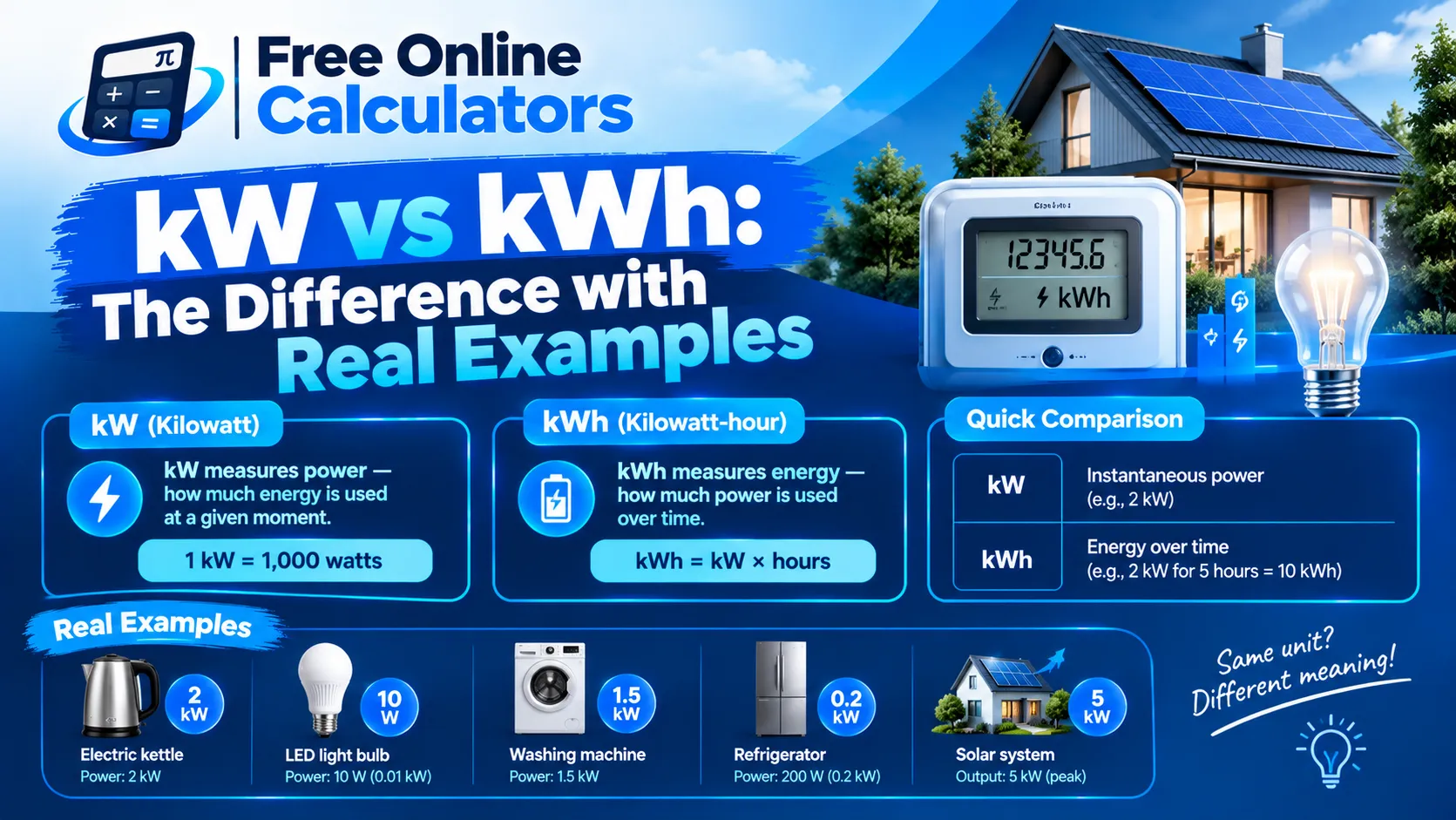
kW vs kWh: The Difference with Real Examples
kW and kWh look almost the same, but they measure different things. A kilowatt is a rate, how fast energy is used or produced. A kilowatt hour is an amount, how much energy was used over time. Your electric bill charges for kWh, while appliances, chargers, and solar panels are rated in kW. This guide explains kW vs kWh with everyday examples.
The relationship
kWh = kW × hours
Think of kW as the speed of a car and kWh as the distance it covers. A 1 kW load running for 1 hour uses 1 kWh; the same load for 5 hours uses 5 kWh.
Space heater example
A 1.5 kW heater running 4 hours a day uses 1.5 × 4 = 6 kWh a day. At 0.16 per kWh that costs 0.96 a day, or about 29 a month. The energy cost calculator runs this for any appliance from its watts and hours.
EV charging example
A 7.2 kW home charger running for 5 hours delivers 7.2 × 5 = 36 kWh from the grid. The car’s battery size, say 75 kWh, is an energy figure, while the charger rating is a power figure. Charging time is energy ÷ power. The EV charging calculator adds charging losses and cost.
Solar example
An 8 kW solar system is rated by its peak power. With 4.5 peak sun hours a day and about 14% losses, it produces roughly 8 × 4.5 × 0.86 × 365 = 11,300 kWh a year. The rating in kW sets how fast it can produce; the kWh figure is what offsets your bill. The solar panel calculator sizes a system from your yearly kWh.
kW vs kWh at a glance
| kW | kWh | |
|---|---|---|
| Measures | Power (rate) | Energy (amount) |
| Found on | Appliance labels, chargers, generators, solar panels | Electric bills, battery capacity, solar production |
| Billed? | Sometimes as a demand charge | Yes, per kWh used |
| Example | A 2 kW kettle | Running it 15 minutes uses 0.5 kWh |
Reading your electric bill
The usage line shows kWh for the billing period. A typical home might use 900 kWh a month, about 30 kWh a day. Some commercial bills also charge for peak kW demand, the highest rate of use in a short window, which is why spreading out large loads can lower a business bill.
Common mistakes
- Writing kW/h. The unit is kWh, kilowatts multiplied by hours.
- Comparing battery kWh with charger kW. One is the tank, the other the flow.
- Using peak watts for daily energy. Appliances rarely draw their peak all the time.
Quick reference
kW is power, kWh is energy: kWh = kW × hours. Turn any rating into energy and cost with an online calculator free to use on CalculateGuide.