

Series vs Parallel Circuits: Resistance, Voltage, and Current
Every circuit with more than one component is wired in series, in parallel, or a mix of both. The choice decides how voltage and current share out and what happens when one part fails. This guide compares series vs parallel circuits with the formulas and a worked example.
Series circuits
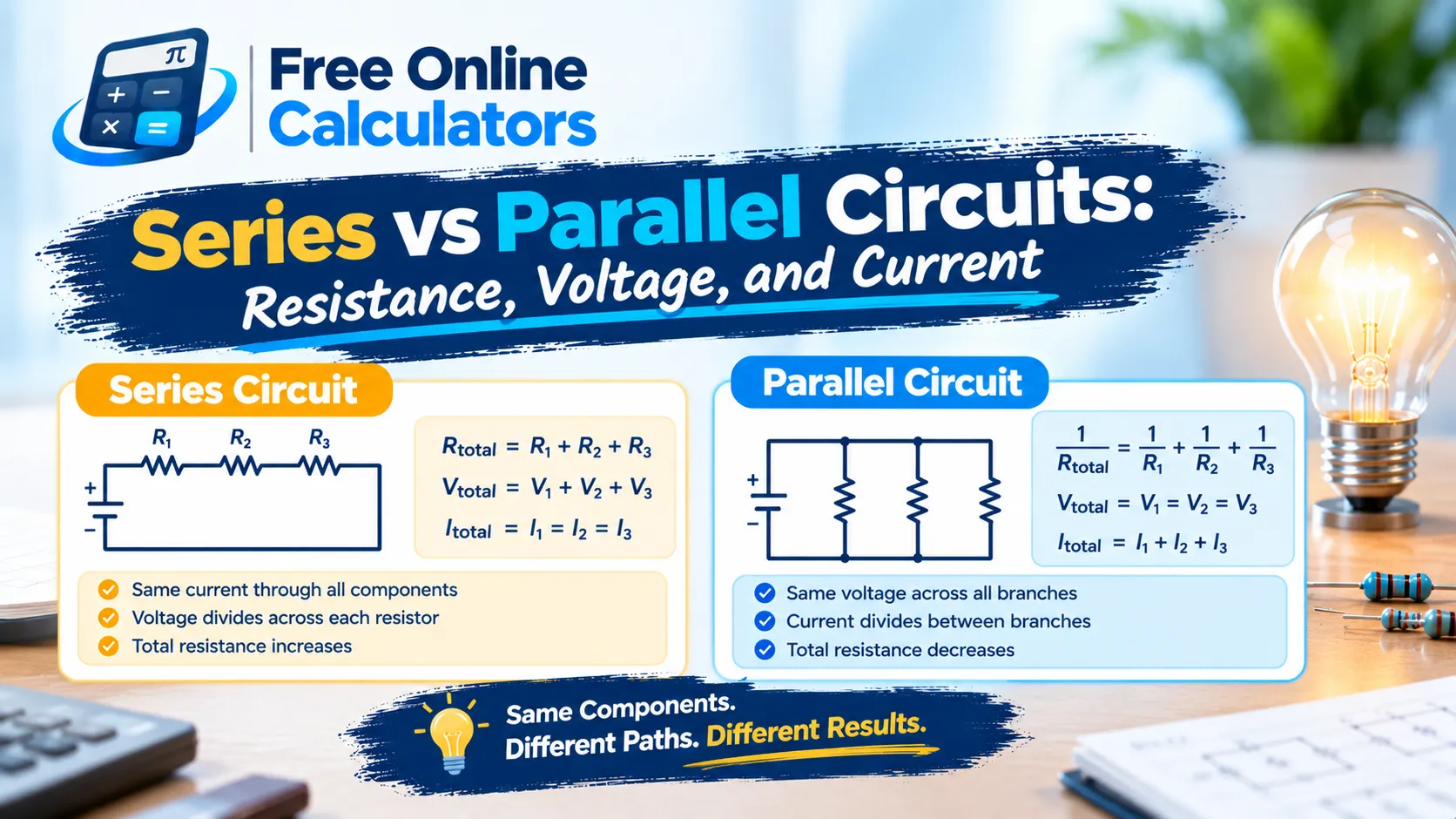
In series, components sit end to end on one path, so the same current flows through each. Resistances add:
Rtotal = R1 + R2 + …
The supply voltage splits across the parts in proportion to their resistance. The series resistance calculator adds any number of resistors.
Parallel circuits
In parallel, each component has its own path between the same two points, so each sees the full supply voltage. Conductances add:
1 ÷ Rtotal = 1 ÷ R1 + 1 ÷ R2 + …
The total is always smaller than the smallest resistor, and the current splits between the branches. The parallel resistance calculator handles any number of branches.
Worked example: 100 Ω and 220 Ω on 12 V
| Series | Parallel | |
|---|---|---|
| Total resistance | 320 Ω | 68.75 Ω |
| Total current | 37.5 mA | 174.5 mA |
| 100 Ω part | 3.75 V, 37.5 mA | 12 V, 120 mA |
| 220 Ω part | 8.25 V, 37.5 mA | 12 V, 54.5 mA |
Each value comes from Ohm’s law, V = I × R. Check any single step with the Ohm’s law calculator.
Series vs parallel circuits compared
| Feature | Series | Parallel |
|---|---|---|
| Current | Same everywhere | Splits between branches |
| Voltage | Splits between parts | Same across each branch |
| Total resistance | Sum, larger than any part | Smaller than the smallest part |
| If one part opens | Everything stops | Other branches keep working |
| Typical use | Voltage dividers, old string lights, current sensing | Household outlets and lights, battery banks for more capacity |
Where each one shows up
Household wiring is parallel, so every outlet gets full voltage and one lamp failing does not cut the others. Series connections appear where you want to split a voltage, as in a voltage divider, explained in the voltage and current divider formula guide. Batteries in series raise voltage; in parallel they raise capacity.
Common mistakes
- Adding parallel resistances directly. Add the reciprocals.
- Assuming equal voltage in series. It splits by resistance.
- Forgetting wire resistance on long runs. It adds in series with the load.
Quick reference
Series: R = R1 + R2, same current. Parallel: 1/R = 1/R1 + 1/R2, same voltage. Solve any network with a free online calculator from CalculateGuide.