

Cable Size Chart & Voltage Drop Formula Explained
Sizing a cable comes down to two checks: it must carry the current without overheating, and it must not lose too much voltage over the run. This guide gives a cable size calculation chart and explains the voltage drop formula behind it.
Cable size chart
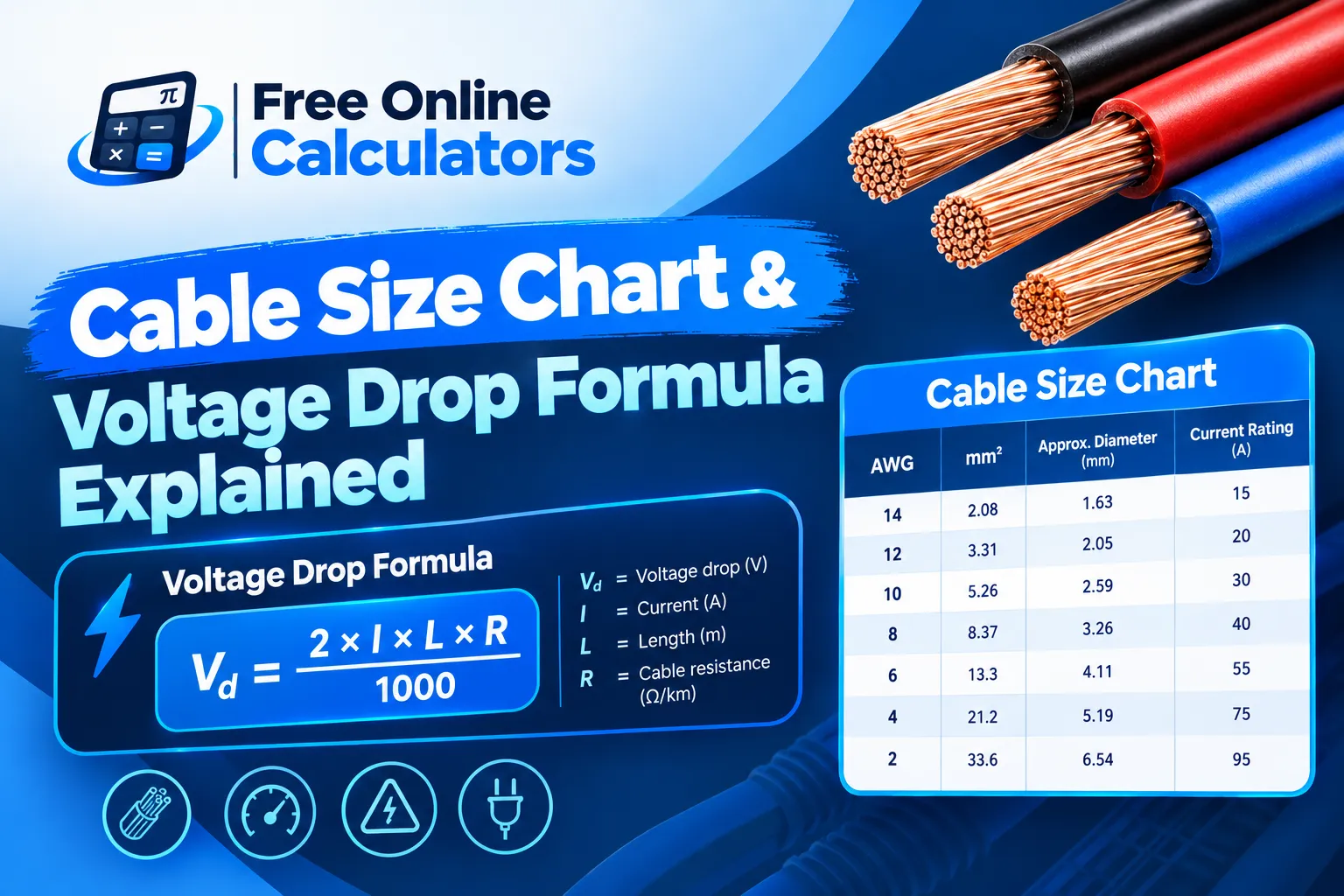
This cable sizing chart lists common copper conductors with their approximate current capacity under reference conditions:
| AWG | mm² (approx) | Typical capacity (A) |
|---|---|---|
| 14 | 2.1 | 15 |
| 12 | 3.3 | 20 |
| 10 | 5.3 | 30 |
| 8 | 8.4 | 40 |
| 6 | 13.3 | 55 |
| 4 | 21.2 | 70 |
These are a starting point. Heat, bunching in conduit, and insulation all reduce capacity, so derate the chart value for the real environment. The wire size calculator checks both current and voltage drop and returns the smallest safe conductor.
The voltage drop formula
Current flowing through a cable loses some voltage to the conductor resistance. The voltage drop formula for a single-phase run is:
Vdrop = 2 × I × R × L
I is the current, R is the resistance per unit length, and L is the one-way length. The factor of 2 counts both conductors, out and back. For three phase the factor becomes √3. The voltage drop calculator evaluates this and gives the loss as a percentage.
Why length decides the cable
On short runs the current rating sets the cable size. On long runs voltage drop takes over, because resistance builds with length, and a cable rated for the current can still deliver too little voltage at the far end. This is the most common sizing error. The exact resistance per metre comes from the wire resistance calculator.
How much voltage drop is acceptable
A common target is 3% for the final circuit and 5% from the source to the load, though your local code sets the real limit. If a run exceeds it, the fixes are a larger conductor, a shorter route, or a higher supply voltage. Low-voltage DC suffers most, since the same loss is a bigger share of a small supply.
Quick reference
Single phase drop: Vdrop = 2 × I × R × L. Three phase: √3 × I × R × L. Target under 3% for the final circuit. Size the conductor first, then confirm the loss, with the free electrical tools on CalculateGuide.