

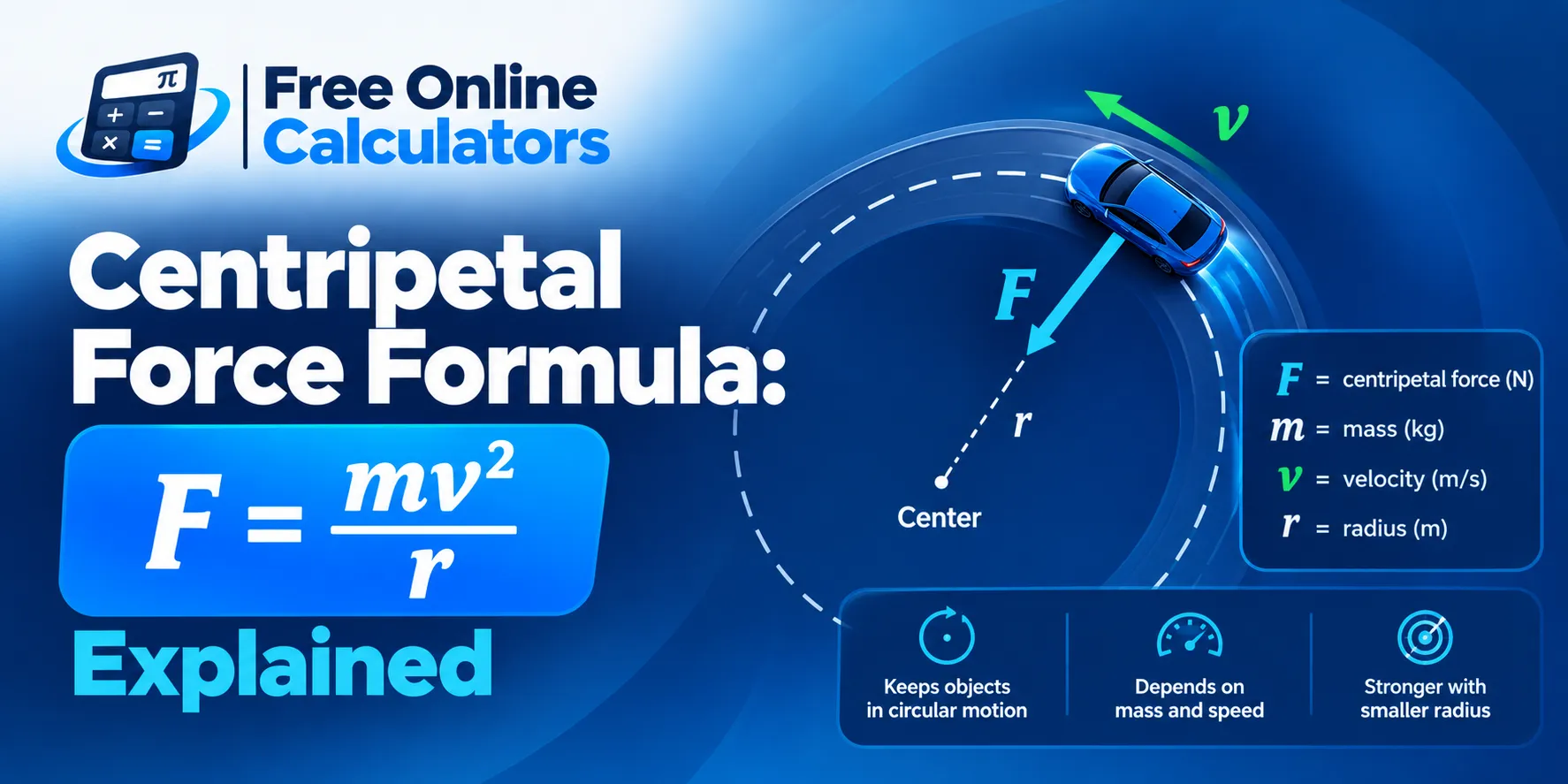
Centripetal Force Formula: F = mv²/r Explained
Any object moving in a circle is pulled toward the centre, and the centripetal force formula gives the size of that inward pull. This guide explains the formula, its link to the centripetal acceleration formula, and how to use both with a worked example.
The centripetal force formula
The centripetal force formula is the mass times the speed squared, divided by the radius:
F = m × v² ÷ r
Here m is the mass in kilograms, v is the speed in metres per second, and r is the radius of the circle. Because the speed is squared, doubling the speed on the same circle needs four times the force, while a wider circle needs less. The centripetal force calculator works this out and also shows the acceleration.
The centripetal acceleration formula
Force is mass times acceleration, so dividing the mass out of the formula gives the centripetal acceleration formula:
a = v² ÷ r
Even at a steady speed, an object on a circle is accelerating, because its direction keeps changing. That acceleration points straight at the centre, which is why the force does too. For straight-line motion, the velocity and acceleration formulas work the same way with a = (v − u) ÷ t.
Worked example
A 2 kg ball on a 5 m string swung at 10 m/s: a = 10² ÷ 5 = 20 m/s², and F = 2 × 20 = 40 N. The string pulls the ball inward with 40 newtons. The tangential speed can come from the velocity calculator if you know the distance and time.
Where the force comes from
Centripetal force is not a new force. It is the net inward force the circle needs, supplied by tension in a string, gravity on an orbit, or friction on a car tyre. If that real force falls short, the object slides outward along a tangent, which is a skid on a curve. The force calculator relates any force to mass and acceleration through F = ma.
Common mistakes
- Forgetting the square. Speed is squared, so small speed changes move the force a lot.
- Using diameter for radius. The formula needs the radius, half the diameter.
- Calling it an outward force. The force and the acceleration both point inward.
Quick reference
Centripetal force: F = m v² / r. Centripetal acceleration: a = v² / r. Put your own numbers into any free online calculator on CalculateGuide to check the result.