

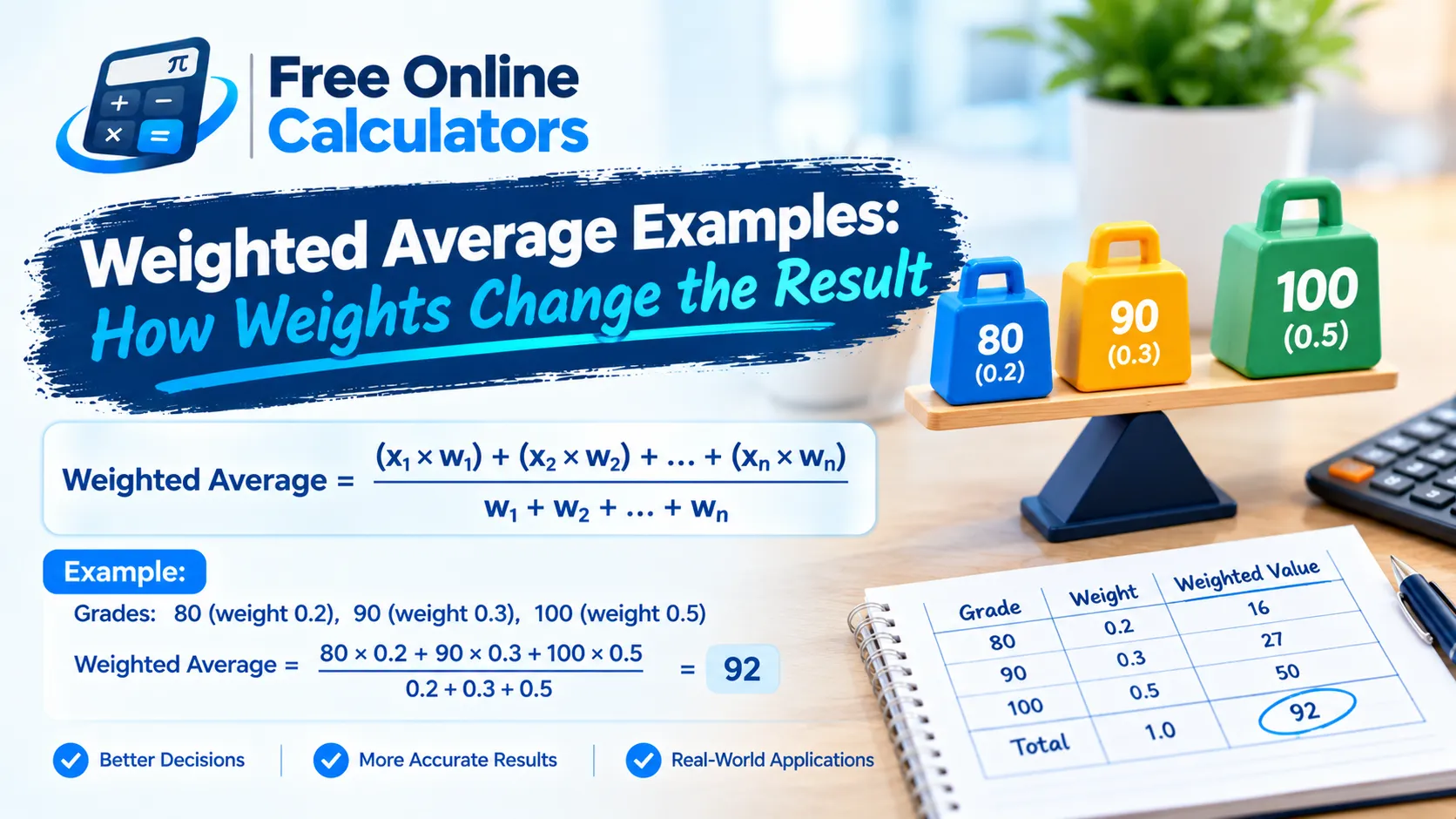
Weighted Average Examples: How Weights Change the Result
A weighted average gives some values more say than others. The idea is simple, but it is easier to see in action. This guide walks through five weighted average examples from school, business, and finance, and shows how the result differs from a plain average each time.
The weighted average formula
Weighted average = Σ(value × weight) ÷ Σweight
If the weights are percentages that add to 100, divide by 100, or use decimals that add to 1 and skip the division. The average calculator handles both plain and weighted averages.
Example 1: course grade
A course weights homework at 20 percent, quizzes at 30 percent, and the final exam at 50 percent. A student averages 90, 80, and 70.
Grade = 0.20 × 90 + 0.30 × 80 + 0.50 × 70 = 18 + 24 + 35 = 77
The plain average of the three scores is 80. The weaker final exam pulls the grade down because it carries half the weight.
Example 2: GPA with credit hours
Grade points are weighted by credits: an A (4.0) in a 3 credit course, a B (3.0) in a 4 credit course, and a C (2.0) in a 2 credit course.
GPA = (4 × 3 + 3 × 4 + 2 × 2) ÷ (3 + 4 + 2) = 28 ÷ 9 = 3.11
The plain average of the grade points is 3.0; the 4 credit B counts most. To turn a CGPA into a percentage for an application, use the CGPA to percentage calculator.
Example 3: average inventory cost
A shop buys 100 units at $10, 200 units at $12, and 50 units at $15.
Average cost = (100 × 10 + 200 × 12 + 50 × 15) ÷ 350 = 4,150 ÷ 350 = $11.86
The plain average of the three prices is $12.33. The weighted figure is the real cost per unit on the shelf, because most units came in at $12.
Example 4: portfolio return
A portfolio holds 60 percent in a fund that returned 8 percent and 40 percent in a bond fund that returned 3 percent.
Return = 0.60 × 8% + 0.40 × 3% = 4.8% + 1.2% = 6.0%
The plain average of 5.5 percent understates the result because more money sat in the better fund.
Example 5: weighted average forecasting
A weighted moving average forecasts next month’s sales from the last three, giving recent months more weight: 0.5, 0.3, and 0.2. Sales were 120 last month, 110 the month before, and 100 before that.
Forecast = 0.5 × 120 + 0.3 × 110 + 0.2 × 100 = 60 + 33 + 20 = 113
A plain three month average would forecast 110 and react more slowly to the rising trend.
When the weights do not add to 1
With weights of 3, 2, and 1 on the same sales: (3 × 120 + 2 × 110 + 1 × 100) ÷ 6 = 680 ÷ 6 = 113.3. Divide by the sum of the weights and the result lands in the same place.
Weighted average examples compared
| Example | Plain average | Weighted average |
|---|---|---|
| Course grade | 80 | 77 |
| GPA | 3.00 | 3.11 |
| Inventory cost | $12.33 | $11.86 |
| Portfolio return | 5.5% | 6.0% |
| Sales forecast | 110 | 113 |
Exam marks with different maximums
Adding raw marks across papers with different totals is a weighted average in which each paper’s weight is its maximum mark. The guide on how to calculate percentage of marks works through that case.
Common mistakes
- Dividing by the count. Divide by the total weight, not the number of values.
- Mixing percent and decimal weights. Use 20 or 0.20 consistently.
- Weights that do not match the values. Pair each value with its own weight before you multiply.
To build any of these in a spreadsheet, see the steps for a weighted average in Google Sheets.
Quick reference
Multiply each value by its weight, add the products, and divide by the total weight. Try your own numbers with an online calculator free to use on CalculateGuide.