

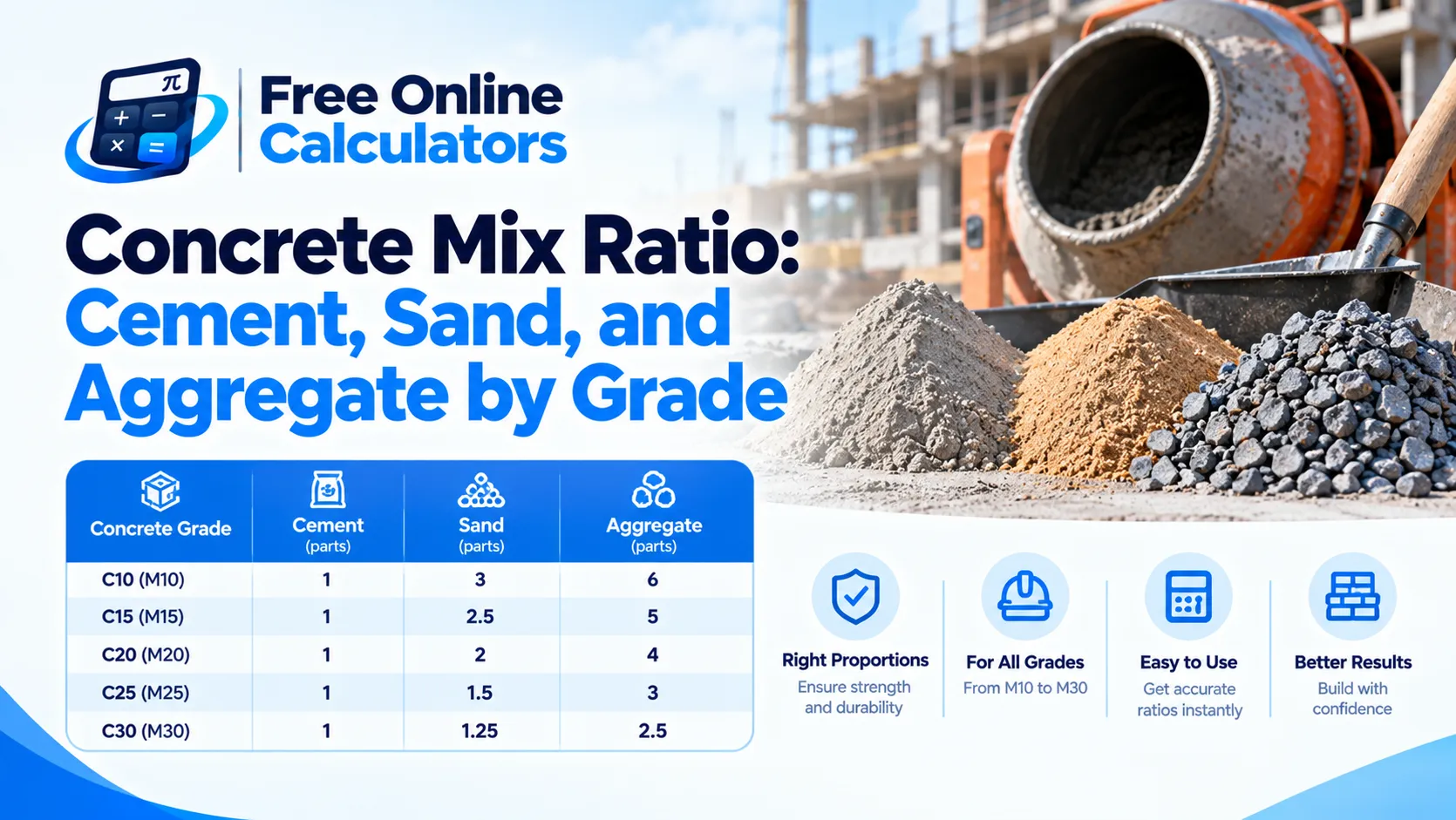
Concrete Mix Ratio: Cement, Sand, and Aggregate by Grade
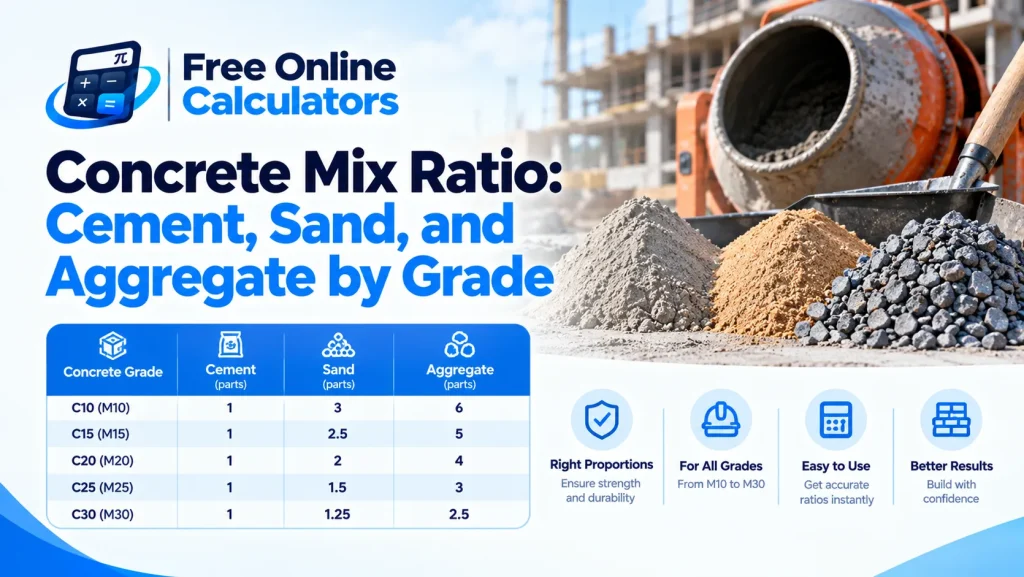
The concrete mix ratio sets how much cement, sand, and coarse aggregate go into each batch, and it decides how strong the concrete will be. This guide lists the common nominal mixes, shows how to work out the materials for one cubic meter, and covers the water you add.
Common concrete mix ratios
Ratios are written as cement : sand : coarse aggregate by volume.
| Grade | Mix ratio | Typical use |
|---|---|---|
| M5 | 1 : 5 : 10 | Lean concrete, leveling course |
| M7.5 | 1 : 4 : 8 | Bedding under footings |
| M10 | 1 : 3 : 6 | Floors on grade, non-structural work |
| M15 | 1 : 2 : 4 | Paths, light slabs, general work |
| M20 | 1 : 1.5 : 3 | Reinforced slabs, beams, columns |
The M number is the target compressive strength in MPa at 28 days. For grades above M20, mixes are designed in a lab rather than set by volume. A general-purpose site mix of 1 : 2 : 3 sits between M15 and M20.
How to calculate materials for 1 cubic meter
Dry materials shrink when water fills the gaps, so multiply the wet volume by about 1.54 to get the dry volume. Then split it by the ratio.
Worked example: M20 (1 : 1.5 : 3)
- Dry volume = 1 × 1.54 = 1.54 m³. Sum of parts = 1 + 1.5 + 3 = 5.5.
- Cement = 1.54 ÷ 5.5 = 0.28 m³ × 1,440 kg/m³ = 403 kg, about 8 bags of 50 kg.
- Sand = 1.54 × 1.5 ÷ 5.5 = 0.42 m³.
- Coarse aggregate = 1.54 × 3 ÷ 5.5 = 0.84 m³.
For the total volume of a slab, footing, or column, start with the concrete calculator.
Water-cement ratio
Water makes the mix workable, but every extra liter weakens it. Keep the water-cement ratio, by weight, around 0.45 to 0.55 for structural work: for 403 kg of cement, that is 180 to 220 liters of water, less any moisture already in the sand. Add water gradually until the mix just holds its shape.
Bagged concrete instead of mixing
For small jobs, premixed bags already contain cement, sand, and gravel in a set ratio; you add only water. The concrete bag calculator tells you how many 40, 60, or 80 lb bags a job needs.
Concrete vs mortar and plaster
Mortar and plaster use only cement and sand, with no coarse aggregate, and richer ratios for a smooth finish. The ratios for wall coats are covered in the plastering cement sand ratio guide.
Common mistakes
- Measuring by shovel. Use a gauge box or bucket for consistent batches.
- Adding water to make placing easier. It cuts strength.
- Forgetting the dry volume factor. Without the 1.54, you run short.
Quick reference
M15 is 1 : 2 : 4, M20 is 1 : 1.5 : 3, and one cubic meter of M20 takes about 8 bags of cement. Estimate any pour with the free building tools on CalculateGuide.