

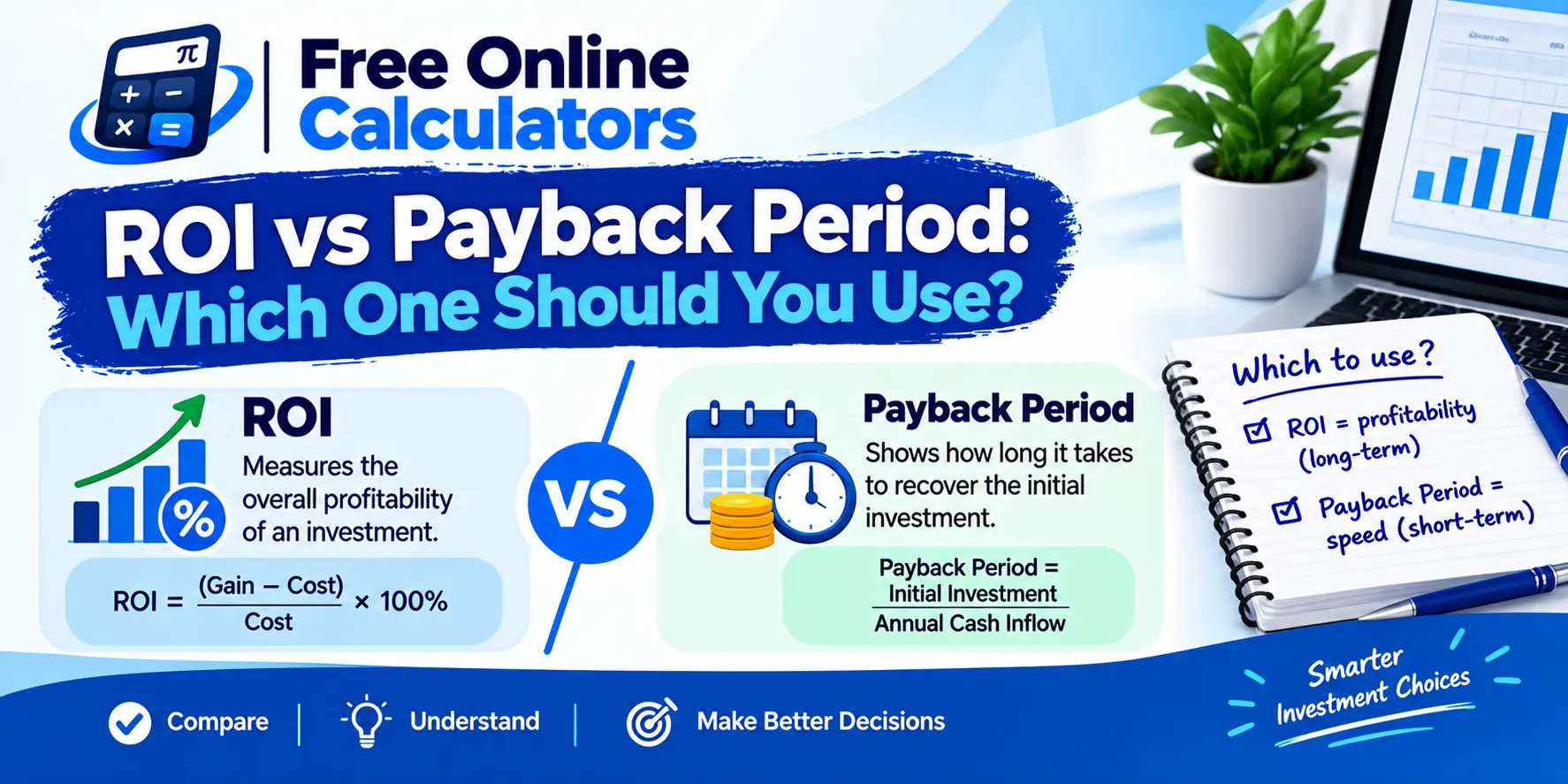
ROI vs Payback Period: Which One Should You Use?
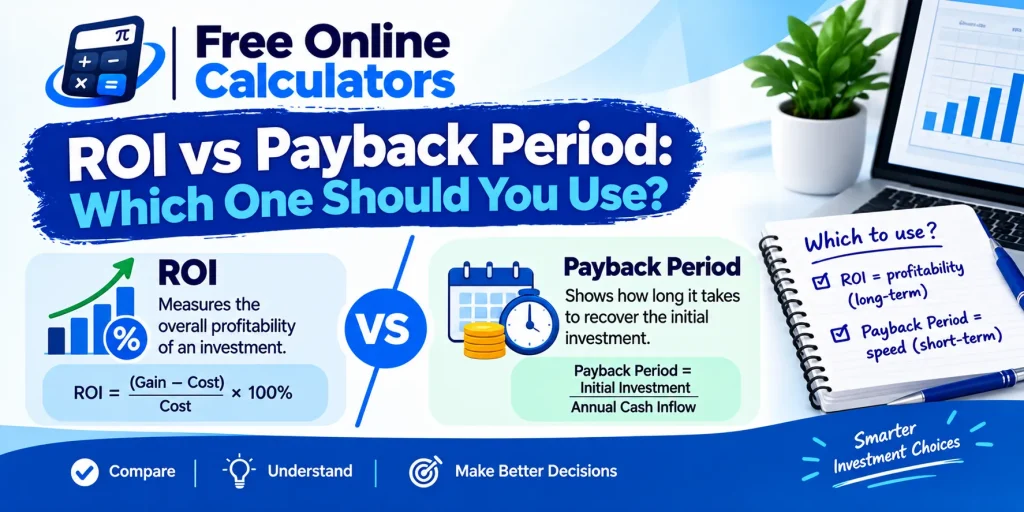
ROI and the payback period are the two quickest ways to judge an investment, and they often disagree. ROI asks how much you earn; the payback period asks how fast you get your money back. This guide compares ROI vs payback period with the formulas, a worked example, and a simple rule for when to use each.
What ROI measures
Return on investment compares the total gain with the money you put in:
ROI = (Total return − Investment) ÷ Investment × 100
It captures every cash flow over the life of the project, but it ignores timing: a 60% ROI over 2 years and over 10 years look the same. The ROI calculator also turns the result into a yearly rate when you enter the years held.
What the payback period measures
The payback period is the time until the cumulative cash flow covers the investment:
Payback = Years before recovery + Unrecovered amount ÷ Cash flow in the recovery year
It rewards fast recovery and ignores everything after it. A project that pays back in 2 years and then stops looks better than one that pays back in 3 years and earns for another 10.
ROI vs payback period: a worked comparison
Two projects each cost 10,000:
| Year | Project A | Project B |
|---|---|---|
| 1 | 4,000 | 2,000 |
| 2 | 4,000 | 3,000 |
| 3 | 4,000 | 5,000 |
| 4 | 4,000 | 8,000 |
| Total | 16,000 | 18,000 |
- Project A: payback = 2 + 2,000 ÷ 4,000 = 2.5 years; ROI = 6,000 ÷ 10,000 = 60%, about 12.5% a year.
- Project B: payback = 3.0 years (2,000 + 3,000 + 5,000 = 10,000); ROI = 8,000 ÷ 10,000 = 80%, about 15.8% a year.
Project A wins on payback, Project B wins on ROI. The payback period calculator gives both the simple and the discounted payback for uneven cash flows like these.
When to use each
- Use payback when cash is tight, the project is risky, or technology may change soon. Fast recovery limits how much you can lose.
- Use ROI when you compare projects of similar length and want the one that earns the most overall.
- Use both for most decisions: set a maximum payback, then pick the highest ROI among the projects that pass.
Where both fall short
Neither measure discounts future money. A dollar in year 4 counts the same as a dollar today, which flatters long projects in ROI and is ignored entirely by simple payback. For a decision that turns on timing, use NPV and IRR, explained step by step in how to calculate IRR.
Common mistakes
- Comparing ROI across different time spans. Turn it into a yearly figure first.
- Stopping payback at whole years. Add the fraction of the recovery year.
- Forgetting running costs. Use net cash flows, not gross revenue.
To build the payback schedule in a spreadsheet, follow how to calculate payback period in Excel.
Quick reference
ROI = gain ÷ investment; payback = time to recover the investment. Check both for your own project with any free online calculator from CalculateGuide.