

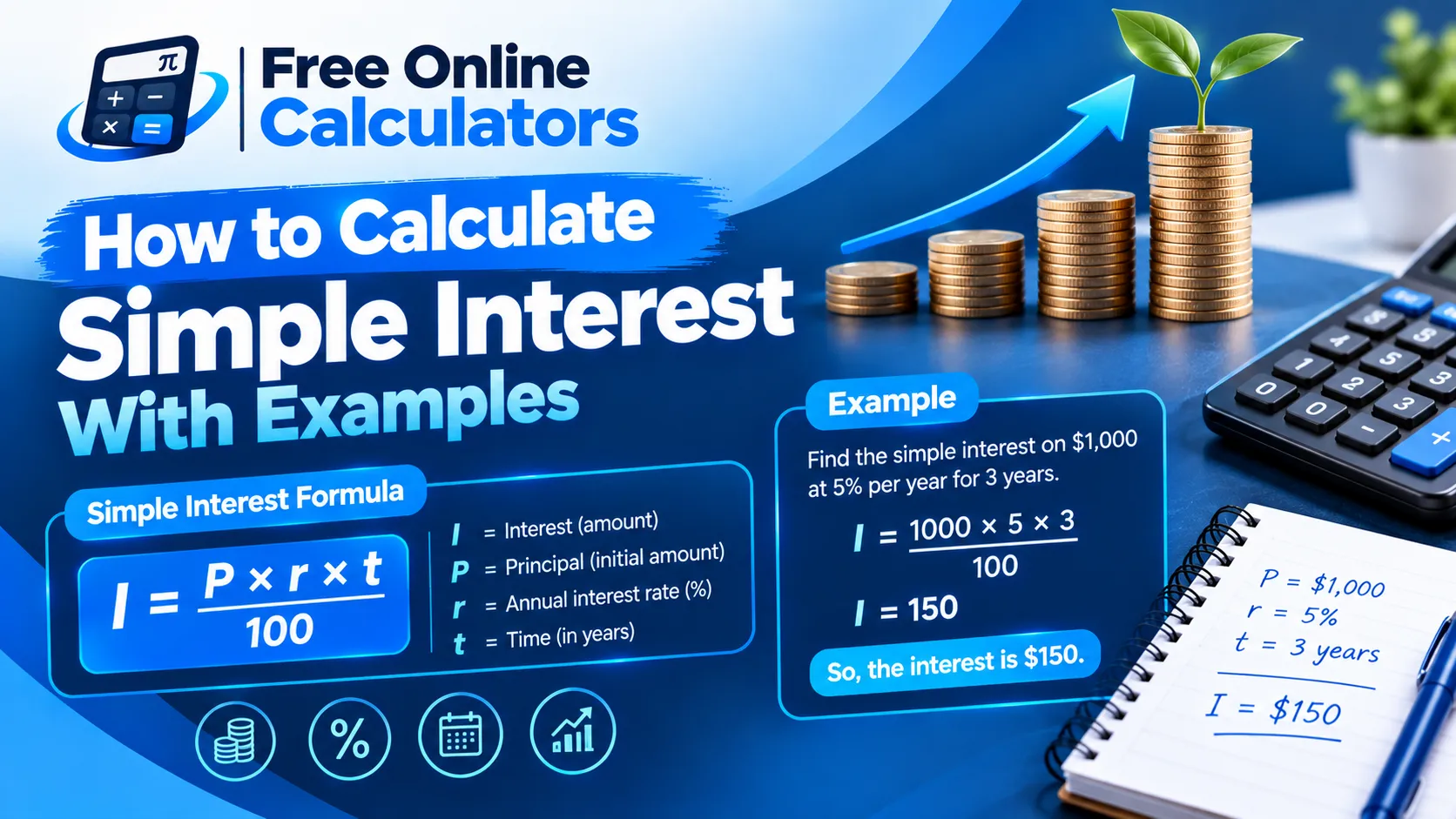
How to Calculate Simple Interest With Examples
Simple interest is the easiest kind of interest to work out: it is charged or earned only on the original amount, never on interest already added. This guide shows how to calculate simple interest step by step, and how to rearrange the same formula to find the principal, the rate, or the time.
The simple interest formula
The simple interest formula multiplies three numbers together:
I = P × R × T ÷ 100
P is the principal (the amount borrowed or invested), R is the annual interest rate in percent, and T is the time in years. The total amount at the end is the principal plus the interest:
A = P + I
How to calculate simple interest step by step
- Write down the principal, the annual rate, and the time.
- Convert the time to years if it is given in months or days.
- Multiply P × R × T and divide by 100.
- Add the interest to the principal if you need the total amount.
Simple interest example
You invest $5,000 at 6 percent a year for 3 years.
I = 5,000 × 6 × 3 ÷ 100 = $900
The total after 3 years is $5,000 + $900 = $5,900. The interest is the same $300 every year, because it is always worked out on the original $5,000.
To skip the arithmetic, the simple interest calculator returns the interest and the total for any principal, rate, and time in years, months, or days.
How to find the principal amount in simple interest
When you know the interest, the rate, and the time, rearrange the formula to find the principal amount:
P = I × 100 ÷ (R × T)
Example: an account earned $900 at 6 percent over 3 years. P = 900 × 100 ÷ (6 × 3) = $5,000.
How to find time in simple interest
To find time in simple interest, divide the interest by the yearly interest:
T = I × 100 ÷ (P × R)
Example: $5,000 at 6 percent earned $900. T = 900 × 100 ÷ (5,000 × 6) = 3 years.
Finding the rate
The same idea gives the rate: R = I × 100 ÷ (P × T). With $900 interest on $5,000 over 3 years, R = 900 × 100 ÷ 15,000 = 6 percent.
Simple interest for months and days
The rate is yearly, so the time must be in years:
- Months: divide by 12. For 18 months, T = 1.5, so $5,000 at 6 percent earns 5,000 × 6 × 1.5 ÷ 100 = $450.
- Days: divide by 365 (some lenders use 360). For 146 days, T = 0.4, so the interest is 5,000 × 0.06 × 0.4 = $120.
More simple interest examples
| Principal | Rate | Time | Interest | Total |
|---|---|---|---|---|
| $1,000 | 5% | 2 years | $100 | $1,100 |
| $5,000 | 6% | 3 years | $900 | $5,900 |
| $12,000 | 4% | 6 months | $240 | $12,240 |
| $20,000 | 8% | 5 years | $8,000 | $28,000 |
Simple interest vs compound interest
Compound interest adds each year’s interest to the balance, so later interest is earned on earlier interest. On the same $5,000 at 6 percent for 3 years, compound interest gives $955.08 instead of $900. The gap grows quickly over long periods, which is why savings accounts use compounding while many car loans and short-term notes use simple interest.
To see the compounding effect for your own numbers, the compound interest calculator shows the future value with annual, monthly, or daily compounding next to the simple interest figure.
Common mistakes
- Forgetting to convert months or days. The rate is per year, so the time must be in years.
- Using the rate as a decimal and dividing by 100 again. Use 6, not 0.06, when you divide by 100.
- Mixing up interest and total. Interest is the extra amount; the total includes the principal.
Simple interest is one piece of the bigger picture. To compare investments with uneven cash flows, see how to calculate IRR.
To see how fast an investment pays for itself, read how to calculate the payback period in Excel.
For any other money question, CalculateGuide has free loan, savings, and investment tools.