

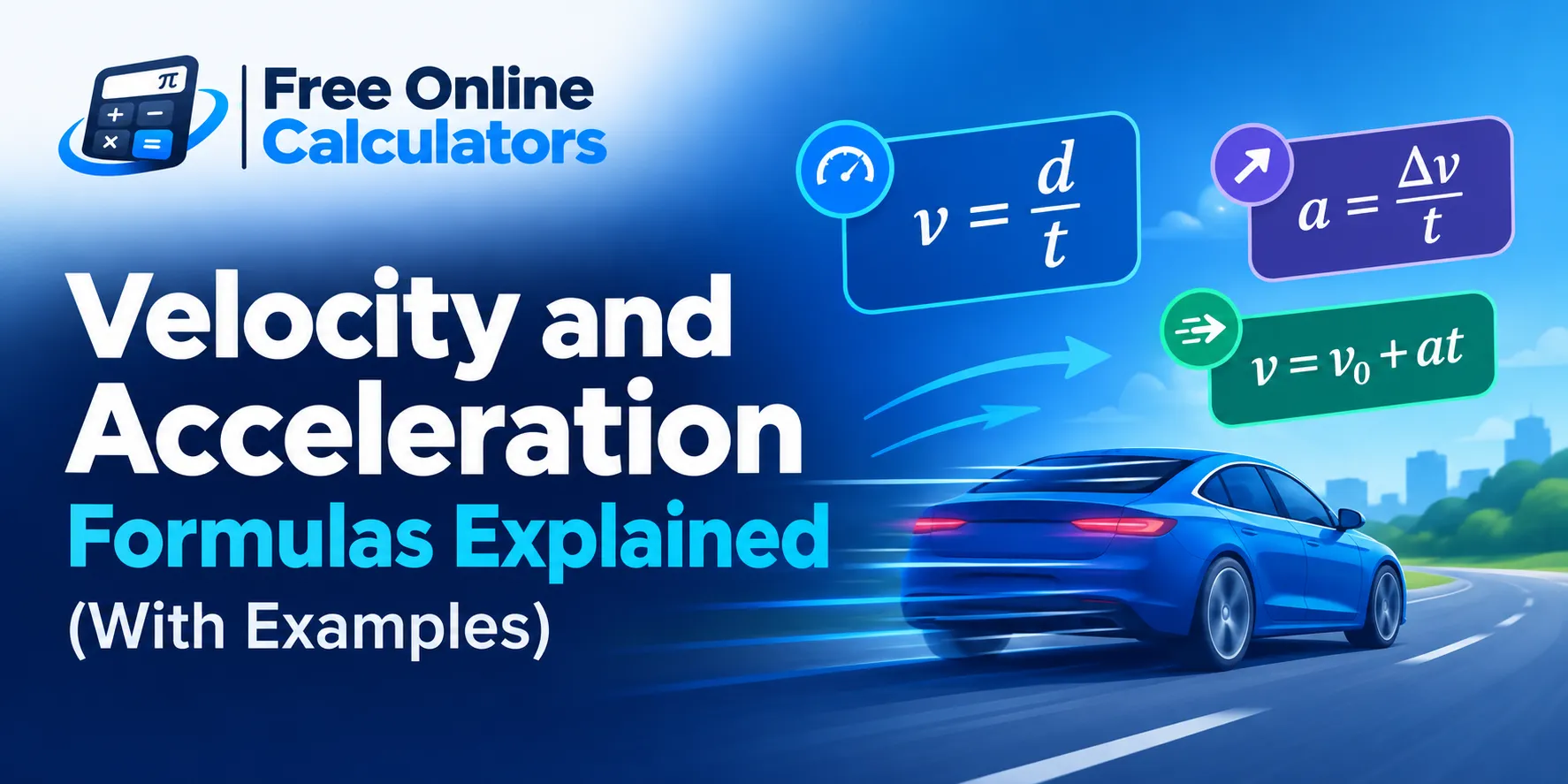
Velocity and Acceleration Formulas Explained (With Examples)
Velocity and acceleration are the two ideas at the heart of motion, and the formula for velocity and the formula for acceleration turn a few measurements into a full picture of how something moves. This guide explains both, shows the equations, and works through examples you can follow step by step.
The formula for velocity
Velocity is speed with a direction. Under constant acceleration, the formula for velocity gives the final velocity from the starting velocity, the acceleration, and the time:
v = u + a × t
Here u is the initial velocity, a is the acceleration, t is the time, and v is the final velocity. Because velocity keeps direction, a negative value simply means motion the other way. If you want the answer without doing the arithmetic, the velocity calculator applies this equation and also returns the distance travelled.
The average velocity formula
When acceleration is constant, the average velocity formula is the mean of the start and end speeds:
Average velocity = (u + v) ÷ 2
This is the single steady speed that would cover the same distance in the same time. It is different from the final velocity, which is the instantaneous speed at the end.
Velocity formula example
An object starts at 5 m/s and accelerates at 2 m/s² for 3 seconds. The formula for velocity gives v = 5 + 2 × 3 = 11 m/s. The average velocity is (5 + 11) ÷ 2 = 8 m/s, and the distance is 24 m.
The formula for acceleration
Acceleration measures how quickly velocity changes. The formula for acceleration is the change in velocity divided by the time it took:
a = (v − u) ÷ t
A positive result means speeding up and a negative one means slowing down, so the same equation covers acceleration and deceleration. The acceleration calculator works this out for you, and gravity, at about 9.8 m/s², is a handy benchmark for judging whether a result is reasonable.
Acceleration formula example
A car reaches 27 m/s from rest in 9 seconds. The acceleration is a = (27 − 0) ÷ 9 = 3 m/s², so its velocity rises by 3 m/s every second. For more practice, work through the acceleration formula examples.
How velocity and acceleration are related
The two formulas are two sides of the same relationship. Acceleration is the rate at which velocity changes, and velocity is what acceleration builds up over time. Rearranging one gives the other: start from the acceleration and a time, and the formula for velocity tells you the resulting speed; start from two speeds and a time, and the formula for acceleration tells you the rate. On a velocity-time graph, acceleration is the slope, which the constant acceleration graphs guide explains line by line.
Common mistakes
- Ignoring direction. Both quantities are vectors; keep the signs consistent when you apply the formula for velocity.
- Confusing average and final velocity. The average velocity formula gives a different number from the final velocity.
- Mixing units. Use metres per second for velocity, metres per second squared for acceleration, and seconds for time.
Quick reference
Final velocity: v = u + a·t. Average velocity: (u + v) ÷ 2. Acceleration: a = (v − u) ÷ t. Distance: u·t + ½·a·t². Try them on any online calculator free of charge on CalculateGuide.