

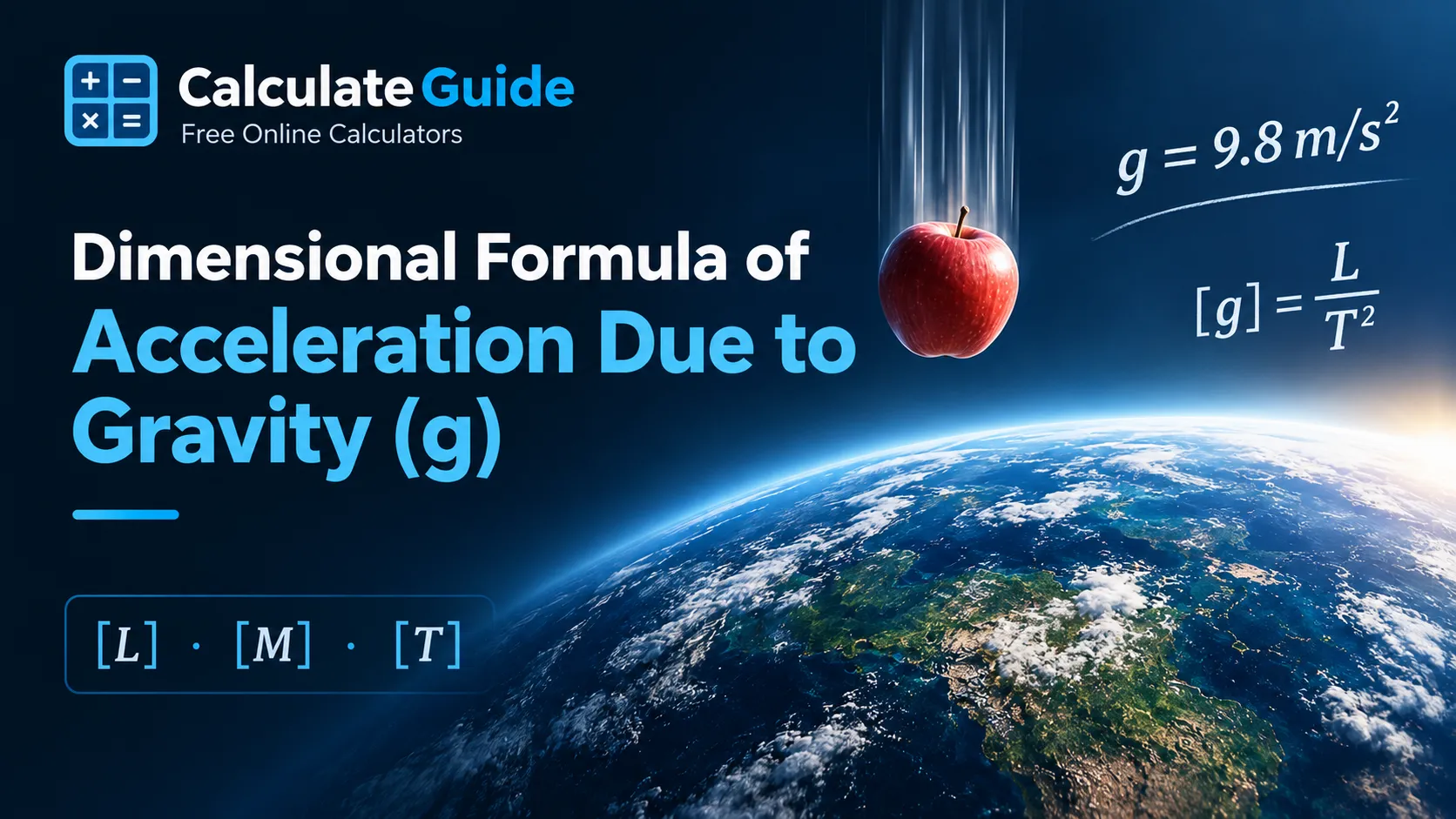
Dimensional Formula of Acceleration Due to Gravity (g)
The acceleration due to gravity, g, is an acceleration like any other, so its dimensions follow from length and time alone. This guide derives the dimensional formula of acceleration due to gravity, compares it with the gravitational constant G, and shows how to use it to check physics equations.
The dimensional formula of g
[g] = [M0 L1 T−2]
Mass does not appear, length appears to the first power, and time appears to the power of minus two. The SI unit that matches these dimensions is metres per second squared, m/s².
Derivation from the definition of acceleration
Acceleration is the change in velocity divided by the time taken:
a = Δv ÷ Δt
- Velocity is distance over time, so [v] = [L T−1].
- Divide by time: [a] = [L T−1] ÷ [T] = [L T−2].
- No mass term appears, so write it as M0: [M0 L1 T−2].
Since g is the acceleration of a body falling freely near the Earth, it carries exactly the same dimensions as any other acceleration. The acceleration calculator works in the same m/s² units.
Derivation from Newton’s law of gravitation
At the surface of a planet of mass M and radius R:
g = G × M ÷ R²
G has dimensions [M−1 L3 T−2]. Multiply by mass [M] and divide by length squared [L2]: [M−1 L3 T−2] × [M] ÷ [L2] = [L T−2]. Both routes agree, which is a good sign the dimensions are right.
g versus G
| Quantity | Symbol | Dimensional formula | SI unit | Value |
|---|---|---|---|---|
| Acceleration due to gravity | g | [M0 L1 T−2] | m/s² | 9.80665 (standard) |
| Gravitational constant | G | [M−1 L3 T−2] | N·m²/kg² | 6.674 × 10⁻¹¹ |
| Weight (force) | W = mg | [M1 L1 T−2] | N | Depends on mass |
g changes from place to place, from about 9.78 m/s² at the equator to about 9.83 m/s² at the poles. G is a universal constant. The gravitational force calculator uses G to find the pull between any two masses.
Using the dimensional formula of g to check equations
Dimensional analysis catches wrong formulas before you plug in numbers. Each side of an equation must have the same dimensions.
Free fall distance: h = ½ g t²
[L T−2] × [T2] = [L]. The right side is a length, matching h.
Impact speed: v = √(2 g h)
√([L T−2] × [L]) = √[L2 T−2] = [L T−1], a velocity. The free fall calculator applies both of these equations.
Pendulum period: T = 2π √(L ÷ g)
√([L] ÷ [L T−2]) = √[T2] = [T], a time. The 2π is a pure number with no dimensions.
g in other unit systems
- SI: 9.80665 m/s²
- CGS: 980.665 cm/s²
- US customary: about 32.174 ft/s²
The numbers change with the units, but the dimensional formula stays [M0 L1 T−2] in every system.
Common mistakes
- Mixing up g and G. g is an acceleration; G is a constant with mass in its dimensions.
- Adding a mass term. Acceleration due to gravity does not depend on the falling body’s mass.
- Writing T−1. That is velocity per unit length; acceleration needs T−2.
The same method gives other dimensional formulas; the torque formula guide shows why torque shares its dimensions with energy.
Quick reference
[g] = [M0 L1 T−2], SI unit m/s², standard value 9.80665 m/s². Run gravity problems with the free physics tools on CalculateGuide.