

Torque vs Horsepower: How They Relate
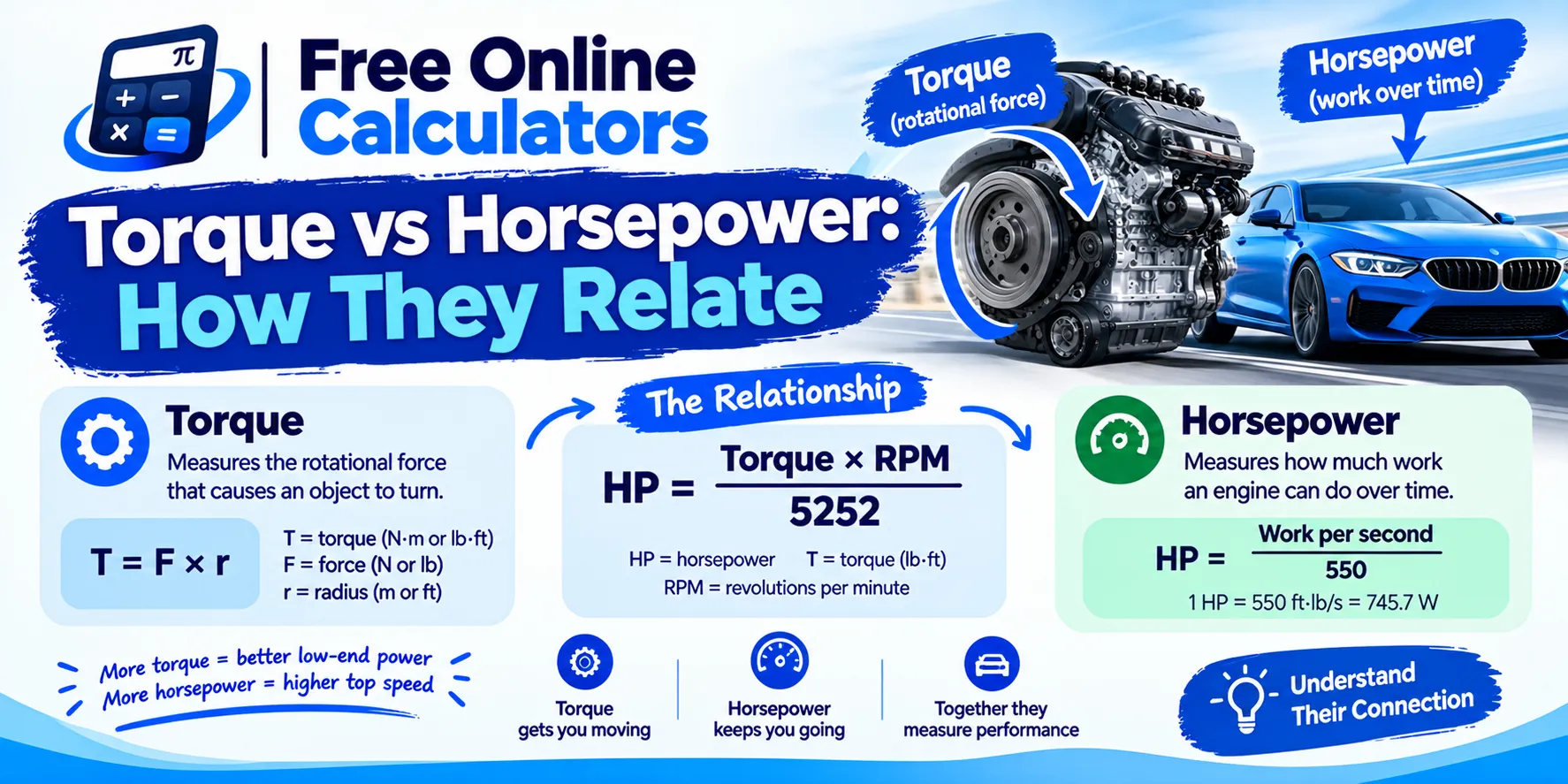
Engine and motor specs list both torque and horsepower, and people argue about which matters more. They are not rivals: horsepower is torque multiplied by speed. This guide explains torque vs horsepower, the formula that links them, and what each one tells you about a car or a machine.
What torque is
Torque is a twisting force, force times the lever arm, measured in pound-feet or newton meters. It is what you feel as the push in your back when a car pulls away, and it decides whether a motor can turn a stiff load at all. The torque formula guide covers T = F × r in detail.
What horsepower is
Horsepower is the rate of doing work: how much torque is delivered how fast. One horsepower is 550 foot-pounds per second, or about 746 watts. High horsepower means the engine can keep delivering torque at high speed, which sets top speed and acceleration at higher revs.
The formula that links them
hp = Torque (lb-ft) × RPM ÷ 5,252
kW = Torque (N·m) × RPM ÷ 9,549
An engine making 300 lb-ft at 4,000 rpm produces 300 × 4,000 ÷ 5,252 = 228 hp at that speed. The horsepower calculator converts between the two at any rpm.
Why the curves cross at 5,252 rpm
At 5,252 rpm the formula divides by itself, so torque in lb-ft and horsepower have the same number. Below that speed the torque figure is higher; above it, horsepower is higher. That is why every dyno chart in these units shows the two curves crossing at 5,252.
Torque vs horsepower in practice
- Diesel trucks make big torque at low rpm, ideal for towing and pulling from a stop.
- High-revving engines make less torque but spin fast, so they reach high horsepower and top speed.
- Electric motors deliver full torque from zero rpm, which is why EVs launch so quickly.
Gearing changes torque, not horsepower
A gearbox trades speed for torque. A 3:1 reduction triples the torque at the wheels and cuts the speed to a third, while the power stays the same minus small losses. That is why a modest engine with the right gearing can still tow. The gear ratio calculator shows the output torque and speed for any ratio.
Which matters more?
For towing, hauling, and low-speed work, look at torque and where in the rpm range it peaks. For acceleration at speed and top speed, look at horsepower. For an overall picture, look at the whole curve, not one peak number. Engine size also shapes both curves, which the engine displacement calculator works out from bore and stroke.
Common mistakes
- Comparing peak numbers at different rpm. Compare the curves.
- Mixing lb-ft with N·m. 1 lb-ft = 1.356 N·m.
- Thinking gearing adds power. It only trades speed for torque.
Quick reference
hp = lb-ft × rpm ÷ 5,252; kW = N·m × rpm ÷ 9,549. Convert your own figures with an online calculator on CalculateGuide.