

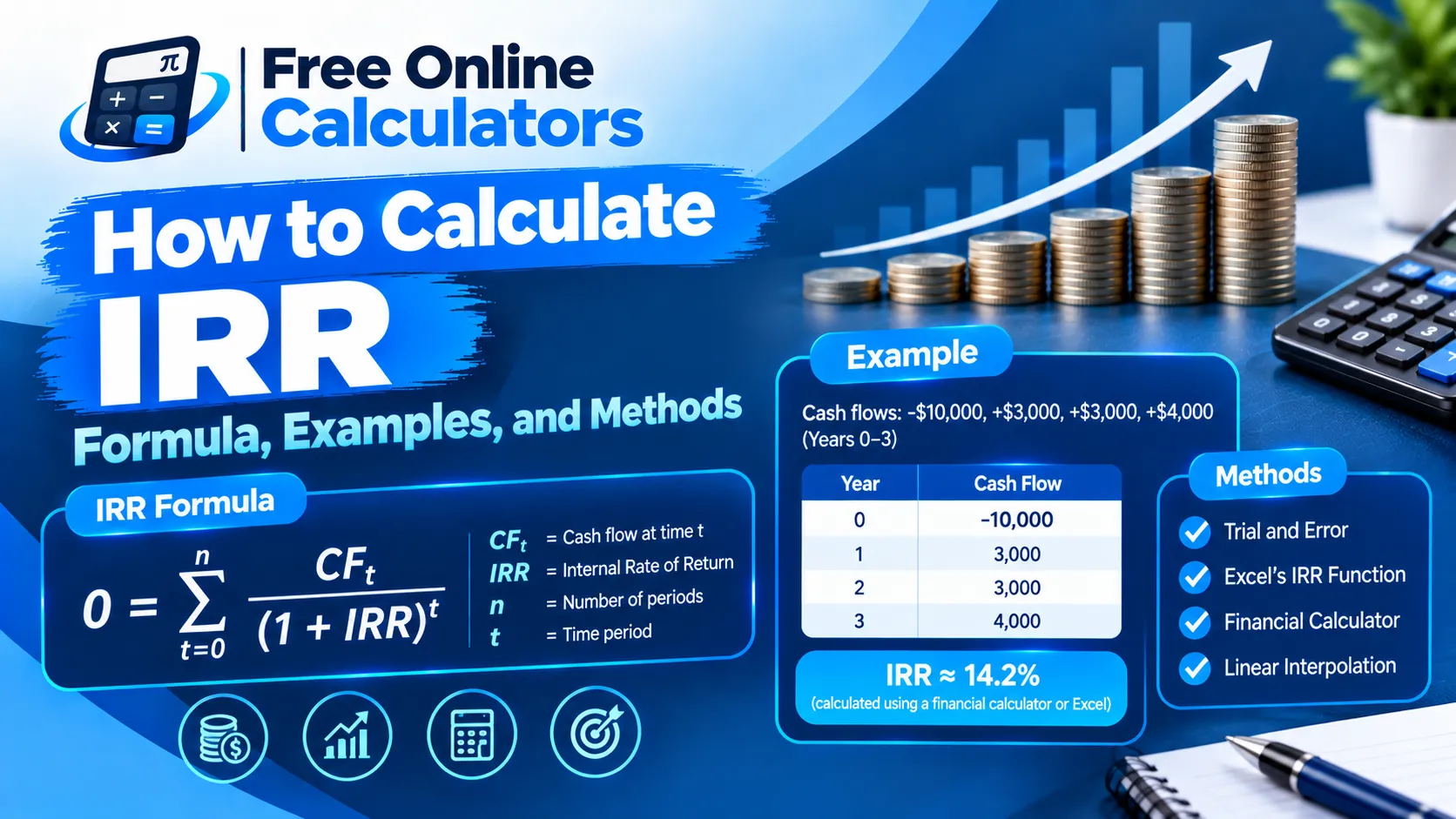
How to Calculate IRR: Formula, Examples, and Methods

The internal rate of return (IRR) is the discount rate that makes an investment’s net present value exactly zero. It turns a string of uneven cash flows into one percentage you can compare with your cost of capital. This guide explains how to calculate IRR manually, how it connects to NPV, and the faster methods you will use in practice.
What IRR means
If a project’s IRR is higher than the return you require, the project adds value; if it is lower, it destroys value. IRR is the break-even interest rate: borrow at a rate below the IRR and the project still pays for itself.
How to calculate NPV with an example
IRR is defined through NPV, so start there. NPV discounts every future cash flow back to today and adds them up:
NPV = Σ CFt ÷ (1 + r)t
CFt is the cash flow in year t, r is the discount rate, and year 0 is the initial investment, entered as a negative number.
NPV example
A project costs $10,000 today and returns $3,000, $4,000, and $5,000 over the next three years. At a 10 percent discount rate:
| Year | Cash flow | Discount factor at 10% | Present value |
|---|---|---|---|
| 0 | −$10,000 | 1.000 | −$10,000.00 |
| 1 | $3,000 | 0.909 | $2,727.27 |
| 2 | $4,000 | 0.826 | $3,305.79 |
| 3 | $5,000 | 0.751 | $3,756.57 |
NPV at 10 percent is −$210.37. Repeat at 8 percent and the present values become $2,777.78, $3,429.36, and $3,969.16, giving NPV = +$176.29.
The IRR formula
IRR is the rate r that solves:
0 = Σ CFt ÷ (1 + IRR)t
There is no way to rearrange this into a single closed formula once there are more than two cash flows, so IRR is always found by trial and improvement.
How to calculate IRR from NPV
To calculate IRR from NPV, find one rate that gives a positive NPV and one that gives a negative NPV. The IRR lies between them. In the example, NPV is positive at 8 percent and negative at 10 percent, so the IRR is between 8 and 10 percent.
How to calculate IRR manually with interpolation
Linear interpolation gives a close estimate without software:
IRR ≈ rlow + NPVlow ÷ (NPVlow − NPVhigh) × (rhigh − rlow)
With the example figures:
IRR ≈ 8% + 176.29 ÷ (176.29 + 210.37) × 2% = 8.91%
The exact IRR is 8.90 percent, so interpolation lands within a hundredth of a percentage point. Narrower brackets give closer answers, because the NPV curve is not a straight line.
How to calculate IRR in Excel or Google Sheets
Put the cash flows in one column, starting with the negative investment, and use:
=IRR(B2:B5)
For cash flows on irregular dates, use =XIRR(values, dates). For NPV, note that Excel’s NPV function assumes the first value is one period in the future, so add the year 0 cash flow separately: =NPV(10%, B3:B5) + B2.
The NPV and IRR calculator runs this search for you: enter the investment and up to five years of cash flows, and it returns the NPV at your discount rate, the exact IRR, and the profitability index.
IRR methods compared
| Method | Accuracy | Best for |
|---|---|---|
| Trial and error | As close as your patience allows | Understanding how IRR works |
| Interpolation | Within a few hundredths of a percent | Exams and quick checks |
| Excel IRR or XIRR | Exact to many decimals | Real decisions |
When an investment has only a starting value and an ending value, its IRR equals the compound annual growth rate, which the CAGR calculator finds directly. To see how quickly the money comes back rather than the rate it earns, the payback period calculator handles up to five years of cash flows.
Limits of IRR
- Multiple IRRs: cash flows that switch sign more than once can give more than one IRR.
- Scale: a small project can have a higher IRR but add less value than a large one. Compare NPV too.
- Reinvestment assumption: IRR assumes cash flows are reinvested at the IRR itself, which can overstate returns. Modified IRR (MIRR) fixes this.
For a simpler first look at an investment, see how to calculate the payback period in Excel.
For the basic interest arithmetic behind all of this, read how to calculate simple interest.
Every finance tool on CalculateGuide is free, so you can compare NPV, IRR, and payback for the same project side by side.